
The carrier and the car: calmer vet trips
The hardest part of a vet visit usually happens in your hallway, not the consulting room. A carrier that lives in the house all year, a cat who chooses to walk in, and a quieter car journey are all trainable — and none of it should ever stand between a sick cat and a vet.
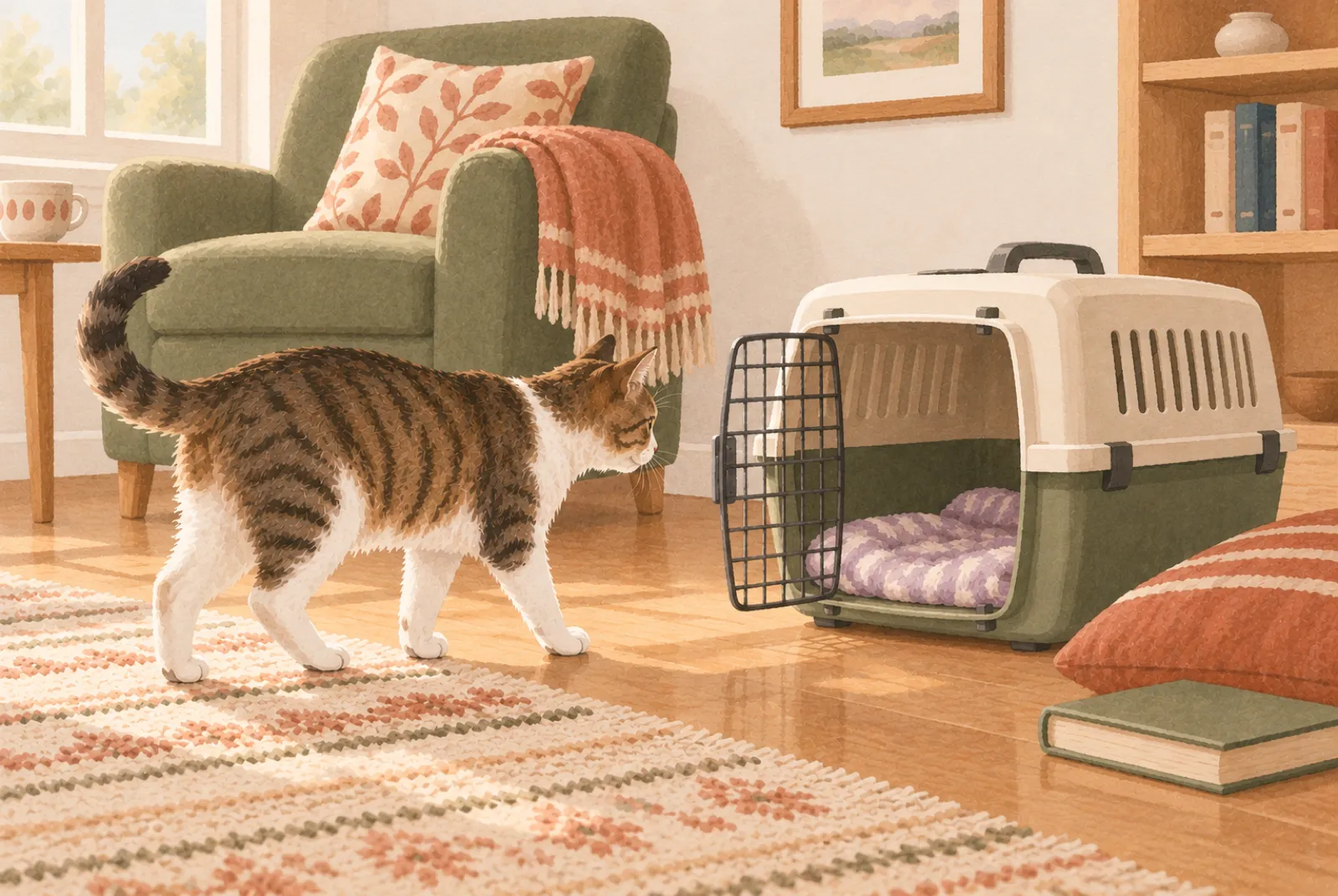
- A carrier that only appears before vet trips teaches the cat to fear it — leave it out all year instead.
- Never transport a cat loose in a car; a secured, covered carrier is calmer for the cat and safer for everyone.
- No carrier struggle should ever delay urgent care — there is always a way to get a cat to a vet.
Why carriers scare cats
None of it is personal. Cats are territorial, sensitive to smell, and deeply invested in control over their own movement — and a vet visit strips away all three at once. International Cat Care lists the stack of stressors: confinement in a small space, unfamiliar surroundings and smells, travel, handling and restraint by strangers, other animals, and the loss of any choice in the matter. The carrier is simply the part the cat can see coming.
Source: International Cat Care on taking your cat to the vet.
It also learns. A carrier that emerges from a cupboard once a year, smelling of dust and predicting the car, becomes a warning sign. Most cats are not happy travellers to begin with — International Cat Care’s travel guidance describes how strongly cats are bonded to their home territory — so the carrier ends up blamed for the whole journey. The fix is to rewrite what the carrier means, which is the next section.
Making the carrier furniture
International Cat Care’s single biggest suggestion: the carrier should be “part of the furniture” — out in the home all the time, somewhere the cat already rests or is fed, not stored between vet trips. Put familiar bedding inside, or a piece of your worn clothing; rub the inside with a soft cloth that has picked up the cat’s facial scent; a synthetic pheromone spray can be misted inside at least 15 minutes before any journey. Introduced well before travel, with treats and the door open, plenty of cats start sleeping in it of their own accord — and a carrier a cat naps in is not a carrier a cat fights.
Sources: International Cat Care on taking your cat to the vet and International Cat Care on travelling with your cat.
The carrier itself matters. Look for something robust and easy to clean — rigid plastic works well — with an opening that suits your cat: a top-opening carrier makes loading a reluctant cat considerably easier than a front door alone. Bigger is not better; a cat should be able to turn and lie down, but a carrier so large they slide about inside feels less secure. Cardboard boxes are temporary solutions only. And each cat travels in their own carrier — sharing reads as confinement with a rival, not company.
Sources: International Cat Care on taking your cat to the vet and International Cat Care on travelling with your cat.
Getting in without force
On the day, calm is the tool. Bring the carrier to the cat’s room rather than chasing the cat to the carrier; open the door and give them a moment to walk in — many cats with a well-worn carrier do. If the cat panics at the sight of it, International Cat Care’s fallback: keep your own body calm, wrap the cat loosely in a towel that smells of home, and place them in quickly but gently — a top-opening carrier earns its keep here. Practice runs on ordinary afternoons, where the cat goes in, the door closes briefly, and then everyone goes back to normal, do more than any single technique.
Source: International Cat Care on taking your cat to the vet.
Rewriting the carrier, week by week
- Furniture firstCarrier lives open in a quiet corner with familiar bedding.
- Good things insideTreats or meals appear near it, then inside it — door open.
- Door practiceClosed for a few seconds while the cat eats, then open again.
- Lift and carryShort practice carries; real trips get easier from here.
The car journey
One rule sits above the rest: never transport a cat loose in a car. A frightened loose cat under a pedal or at a window is a danger to everyone in the vehicle, and escape into a road is a real risk every time a door opens. The carrier travels secured — wedged in the footwell behind a front seat, or belted on the back seat — so it cannot slide or tip. International Cat Care suggests covering it with a cloth or towel to keep the world visually quiet, and sitting it level on a towel or padding.
Sources: International Cat Care on taking your cat to the vet and International Cat Care on travelling with your cat.
Drive gently, keep the radio low, and speak to the cat in your normal calm voice — many cats meow through the journey, which sounds awful but is usually protest rather than crisis. Two hard warnings from the travel guidance: never put the carrier in the boot, and never leave a cat in a parked car in warm weather — heat builds faster than people expect and heatstroke can be fatal.
At the clinic and home again
The waiting room is its own small challenge — dogs, noise, other cats. International Cat Care suggests asking at reception whether there is a cat-only area or a raised shelf for the carrier — cats cope better off the floor, away from sniffing noses at carrier height — and keeping the carrier covered. If your cat finds the room very stressful, waiting together in the car until the vet is ready is a reasonable ask; clinics accredited under International Cat Care’s Cat Friendly Clinic programme have thought about all of this already. In the consulting room, give the cat a moment to settle before the examination begins.
Source: International Cat Care on taking your cat to the vet.
Coming home is not always the end of it. A returning cat carries unfamiliar clinic smells, and housemate cats may treat them as a stranger — International Cat Care advises reintroducing gently, keeping them apart for a few hours or even a day or two if needed, with the returning cat in a quiet, warm spot with food, water and a tray nearby. A cat recovering from sedation may be groggy; anything that worries you in the days after goes back to the clinic. The vet-visit notes guide covers what to write down before and after the appointment.
Source: International Cat Care on taking your cat to the vet.
Never skip urgent care over a carrier
Everything above is about making routine trips easier — the ASPCA’s general care guidance puts a veterinary exam at least once a year on the routine list — but the rule that matters most applies to the bad days: a cat who needs a vet needs a vet, however much they hate the box. If the carrier is a battle, the towel-wrap from the loading section still applies — it helps you place the cat into a secure carrier; it is not a way to carry them. A frightened cat loose in a car or in your arms on a pavement can escape or be hurt, so the cat always travels contained. And if you genuinely cannot get the cat into any secure carrier, phone the practice before you set off — clinics handle transport-difficult cats every day and will tell you the safest way to bring yours in.
Sources: ASPCA general cat care and International Cat Care on taking your cat to the vet.
Takeaway: Make the carrier boring furniture, load without force, keep the car quiet and secured — and never let a bad carrier morning stand between a sick cat and a vet.
Sources and review
- International Cat Care: taking your cat to the vet
- International Cat Care: travelling with your cat
- ASPCA: general cat care
Sources last checked 2026-10-01. Sources support the statements near them; these organisations do not endorse Cat Says Hi.
Spotted an error? Tell us.
Keeping an everyday eye on things
A calm photo note returns an AI-generated, provisional read of a cat’s coat, markings and posture, with everyday care ideas to go with them. Nothing is sent until you select Analyze, and it is never a health check. Read the Privacy Policy for the full data-handling details.