
How many litter boxes, and where to put them
The one-per-cat-plus-one rule, where litter boxes work best in a home, common placement mistakes, and when box avoidance means a vet visit.
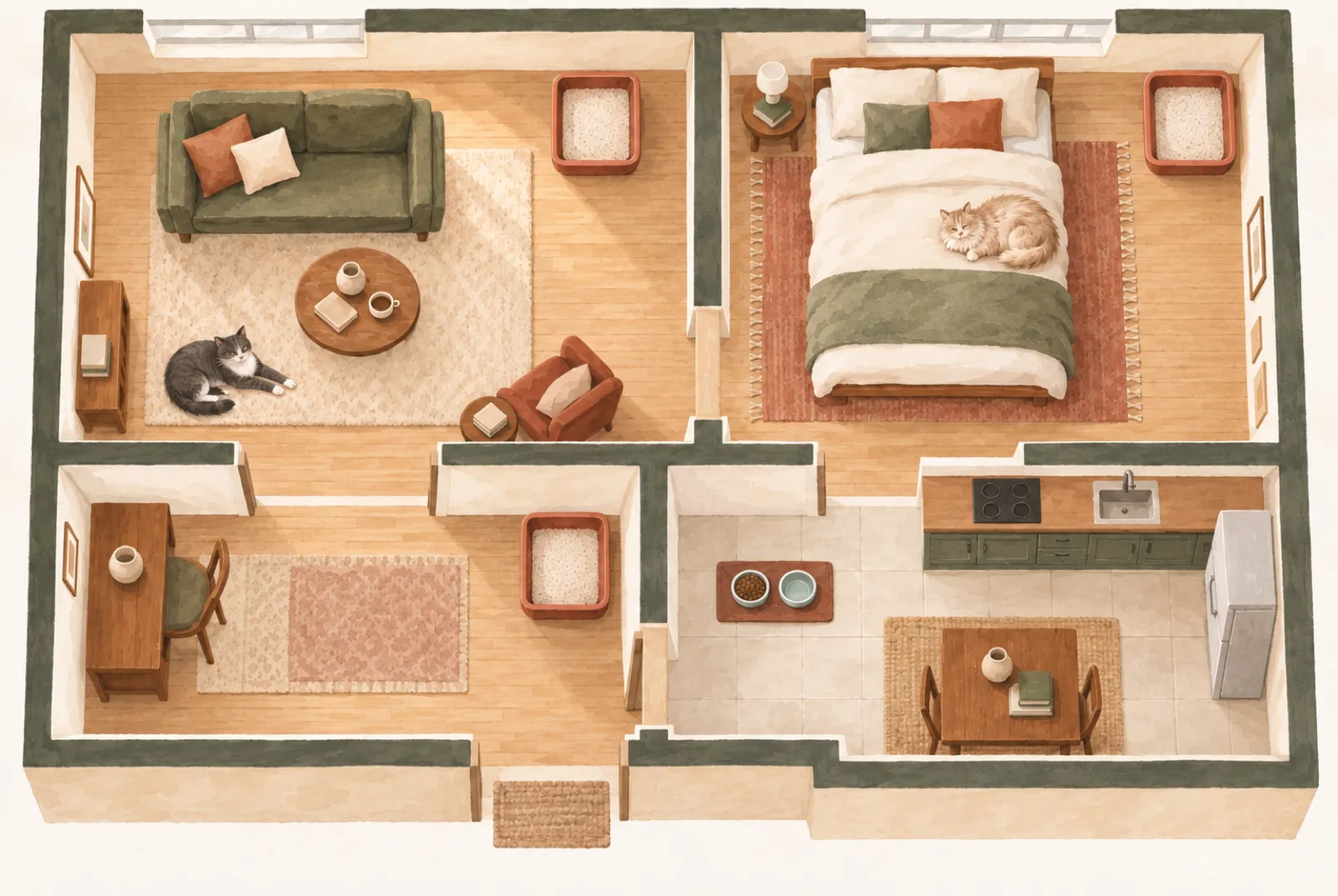
The one-more-than-cats rule
The Ohio State University’s Indoor Pet Initiative puts the rule plainly: “one litter box per cat, plus one.” One cat gets two boxes; two cats get three. Each cat needs a place to eliminate that feels like their own, and spare boxes stop queues, guarding and accidents when the favourite spot is occupied or stale.
Source: Indoor Pet Initiative on litter boxes.
Spread matters as much as count. In a home with more than one level, put boxes on each floor — the Indoor Pet Initiative notes cats dislike walking far to reach a tray, and the ASPCA’s care guidance makes the same one-box-per-floor recommendation. A basement-only setup quietly fails a cat who lives upstairs.
Sources: Indoor Pet Initiative on litter boxes and ASPCA general cat care.
Location basics: quiet, accessible, away from food
Cats want privacy without isolation. Choose a low-traffic spot where the cat can see the room and not be cornered — the Indoor Pet Initiative advises keeping boxes away from appliances or air ducts that switch on suddenly, and away from spots where people or other pets can sneak up. A washing machine mid-spin next to the tray is a classic way to teach a cat to avoid it.
Keep the box genuinely easy to reach: not wedged under a sink, not behind furniture the cat must climb over, and — an easy thing to forget — nowhere near the food and water bowls. Cats prefer to eat and toilet in separate areas. Our first-days checklist builds a new cat’s room around the same separation.
A good spot, a poor spot
Works well
A quiet corner in a lived-in room: easy path in, more than one way out, well away from bowls.
Often fails
Beside a washer that starts suddenly, or three trays lined up in one utility room.
Multi-cat placement mistakes
Three boxes in a row are, to a cat, one box. If all the trays share a room — or worse, a corner — a bolder cat can control the whole resource in one glance. Spread them across different rooms so no cat has to pass another cat’s territory to toilet.
Cornell’s house-soiling guidance adds a subtler point: a cat who is ambushed at the box, or exits into a wall of watching pets, learns the box is dangerous. Position each box so the cat has more than one way out — not hemmed in on three sides — and give a nervous cat a box with a clear view of its surroundings.
Box style and litter texture
Size first: the Indoor Pet Initiative’s rule is that the box should be large enough for the cat to stand on all fours and turn around in. Many cats prefer large, uncovered boxes; covered boxes keep the sightlines out but concentrate odour, so they only work if kept very clean. Kittens and older cats do better with low sides they can step over easily.
On litter itself, research summarised by the Indoor Pet Initiative finds most cats prefer a fine-grained, unscented litter, filled deep enough to dig and bury — about two inches. Once a cat has accepted a litter, change is risky: offer any new litter in a second box beside the old one and let the cat choose, rather than switching overnight. And skip the air freshener beside the tray — a smell that bothers you bothers the cat more.
Two small details also matter. Plastic liners catch on claws and put some cats off digging; self-cleaning boxes can frighten a nervous cat mid-use. If you want to try either, offer the new setup as a choice beside the familiar box rather than a replacement — the cat’s preference decides, not the product.
A simple daily rhythm
The routine the sources agree on is short: scoop at least once a day, and wash the box weekly with mild detergent. The ASPCA adds a caution against ammonia, deodorants and strong scents — lemon especially — when cleaning, and notes that a cat refusing a messy, smelly box is behaving entirely reasonably.
Sources: Indoor Pet Initiative on litter boxes and ASPCA general cat care.
Moving a box? Do it gradually — a few inches a day — rather than relocating it in one jump. Cats build strong habits around place, and a sudden move reads as a missing box.
Source: ASPCA general cat care.
When box avoidance needs a vet visit
House soiling is the most common behaviour problem cat owners report — and the first question is medical, not managerial. Cornell lists urinary tract inflammation, kidney and thyroid disease, diabetes, digestive problems and age-related mobility change as possible causes, and recommends a veterinary examination before treating the problem as behavioural. Cats with medical conditions do not always act sick.
Source: Cornell Feline Health Center on house soiling.
Straining to urinate, passing little or no urine, or blood in the urine are urgent signs — that is an emergency call, not a litter-management question. For subtler changes, our vet-notes guide shows how to record what you see so the conversation at the clinic starts from facts. Spraying — small amounts of urine on vertical surfaces from a standing cat — is a different pattern Cornell distinguishes from ordinary soiling, and it has its own territory-related causes worth reading there.
Takeaway: One box per cat plus one, spread out, kept clean — and when a cat stops using them, ask the vet first.
Sources and review
- Ohio State Indoor Pet Initiative: litter boxes
- Cornell Feline Health Center: house soiling
- ASPCA: general cat care
Sources last checked 2026-09-29. Sources support the statements near them; these organisations do not endorse Cat Says Hi.
Spotted an error? Tell us.
Keeping an everyday eye on things
A calm photo note can help you watch your cat’s visible traits over time. Nothing is sent until you select Analyze, and the result is never a health check — toileting changes belong with a vet. Read the Privacy Policy for the full data-handling details.