
Everyday cat play and enrichment, without pressure
Build a small, safe play routine with toys, places to hide and explore, and choices that fit the individual cat.
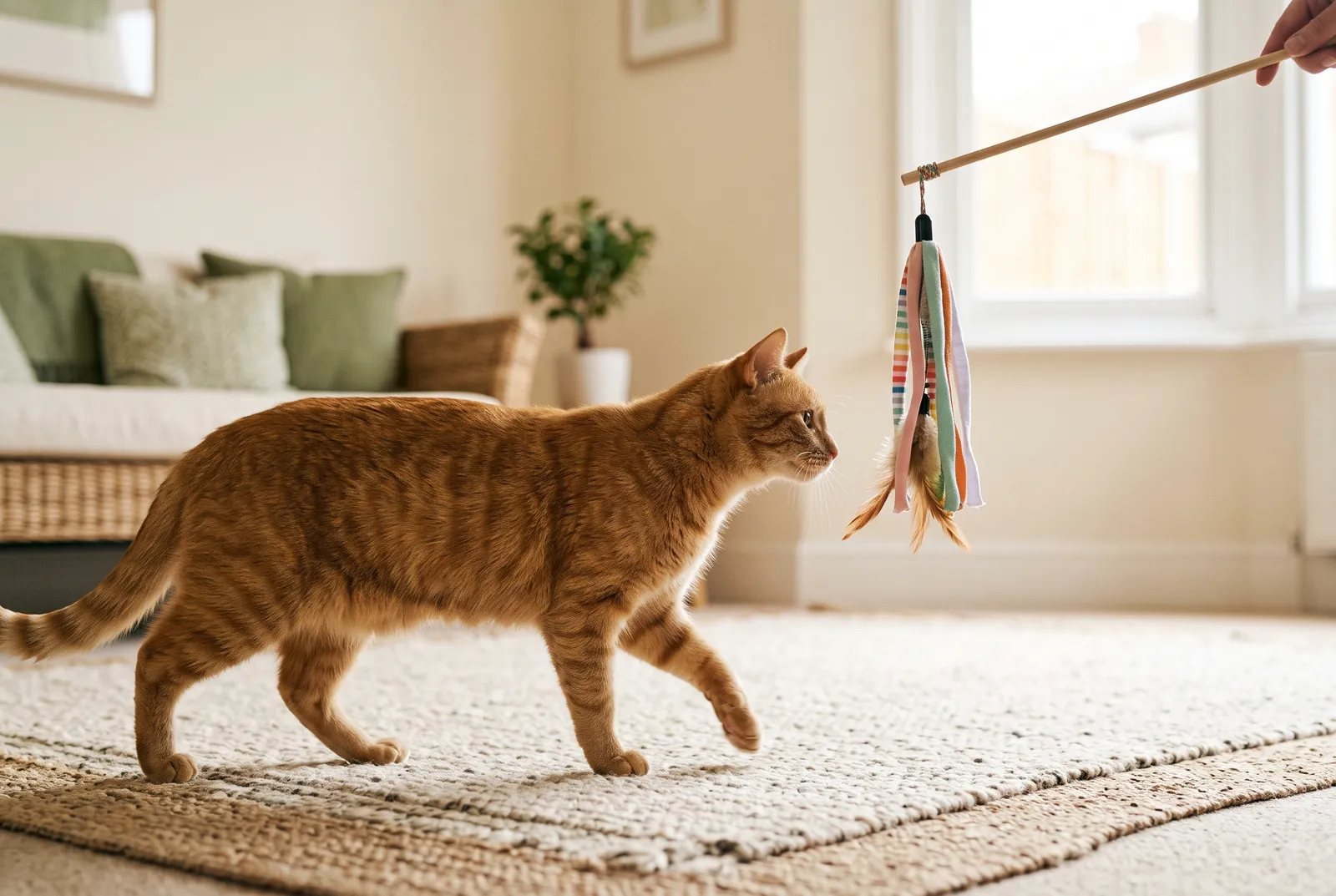
Start with choice
Play and exploration are ordinary parts of a cat’s day. Cats Protection recommends an environment with places to hide, perch and rest, scratching opportunities, toys, and, where suitable, feeding puzzles. The mix should suit the individual cat and household.
Source: Cats Protection behaviour guide on enrichment (PDF).
Offer a toy rather than putting it against the cat. A wand toy can move away from the cat, pause, and let them choose whether to follow. Keep hands out of the toy’s role. Allow a catch now and then instead of making the toy impossible to reach. If the cat loses interest, stop. A few calm minutes can be enough to learn what they enjoy; there is no need to force a fixed target for every cat.
Sources: Cats Protection behaviour guide (PDF) and Cats Protection on indoor and outdoor cats (PDF).
A voluntary play sequence
- OfferMove a wand toy away from the cat and pause; keep hands out of the game.
- Chase or watchThe cat chooses whether to follow, stalk, or simply watch.
- CatchLet the cat catch the physical toy now and then.
- StopEnd when the cat loses interest; a few calm minutes can be enough.
Give play a place to land
A cardboard box can offer a hiding spot. A stable perch can give a view of the room. A scratching surface near an area the cat uses can make the environment more interesting. Try one change at a time and watch whether the cat chooses it.
A choice-rich room, from above
- A hiding spotA box or covered space the cat can slip into.
- A stable perchSomewhere raised with a view of the room.
- A scratching surfaceNear an area the cat already uses.
- A safe resting spotA quiet place to settle undisturbed.
For food puzzles, use part of the cat’s normal food allowance and follow veterinary advice if the cat has a prescribed diet or feeding plan. International Cat Care describes simple puzzle feeders and reminds carers to count puzzle food within the daily ration.
Sources: Cats Protection behaviour guide (PDF) and International Cat Care kitten booklet (PDF).
Check toys for loose pieces, string, or parts that can be swallowed. Cats Protection advises against leaving a cat alone with fishing-rod toys because of entanglement risk. Put those away after play. It also cautions that a laser spot with no physical object to catch may frustrate a cat.
Notice preference, then vary gently
Some cats chase, others watch from a safe place or investigate a box much later. Rotate a small number of safe options if novelty helps, but keep familiar places available. An older or less mobile cat may choose lower, easier-to-reach spaces. The point is opportunity, not performance.
A sudden drop in play, reluctance to jump, hiding, or another clear change from your cat’s usual routine can have several causes. Ask a veterinarian about it rather than treating a new toy as the solution.
Takeaway: Offer safe choices, let the cat set the tempo, and keep an eye on meaningful changes.
Sources and review
- Cats Protection: behaviour guide on environmental enrichment (PDF)
- Cats Protection: indoor and outdoor cats (PDF)
- International Cat Care: kitten booklet (PDF)
- Cornell Feline Health Center: is your cat slowing down?
Sources last checked 27 September 2026. Sources support the statements near them; these organisations do not endorse Cat Says Hi.
Add a photo when you’re ready
Choose a photo locally, review it, and select Analyze to send it. The result offers visible traits and everyday care ideas — never a diagnosis or a breed certificate.