
Cats and children: calm introductions and fair rules
Children and cats get along best inside a small set of fair rules: the cat comes to you, hands are gentle, and the cat always has somewhere to be left alone. This guide turns those rules into something a child can follow and an adult can quietly enforce.
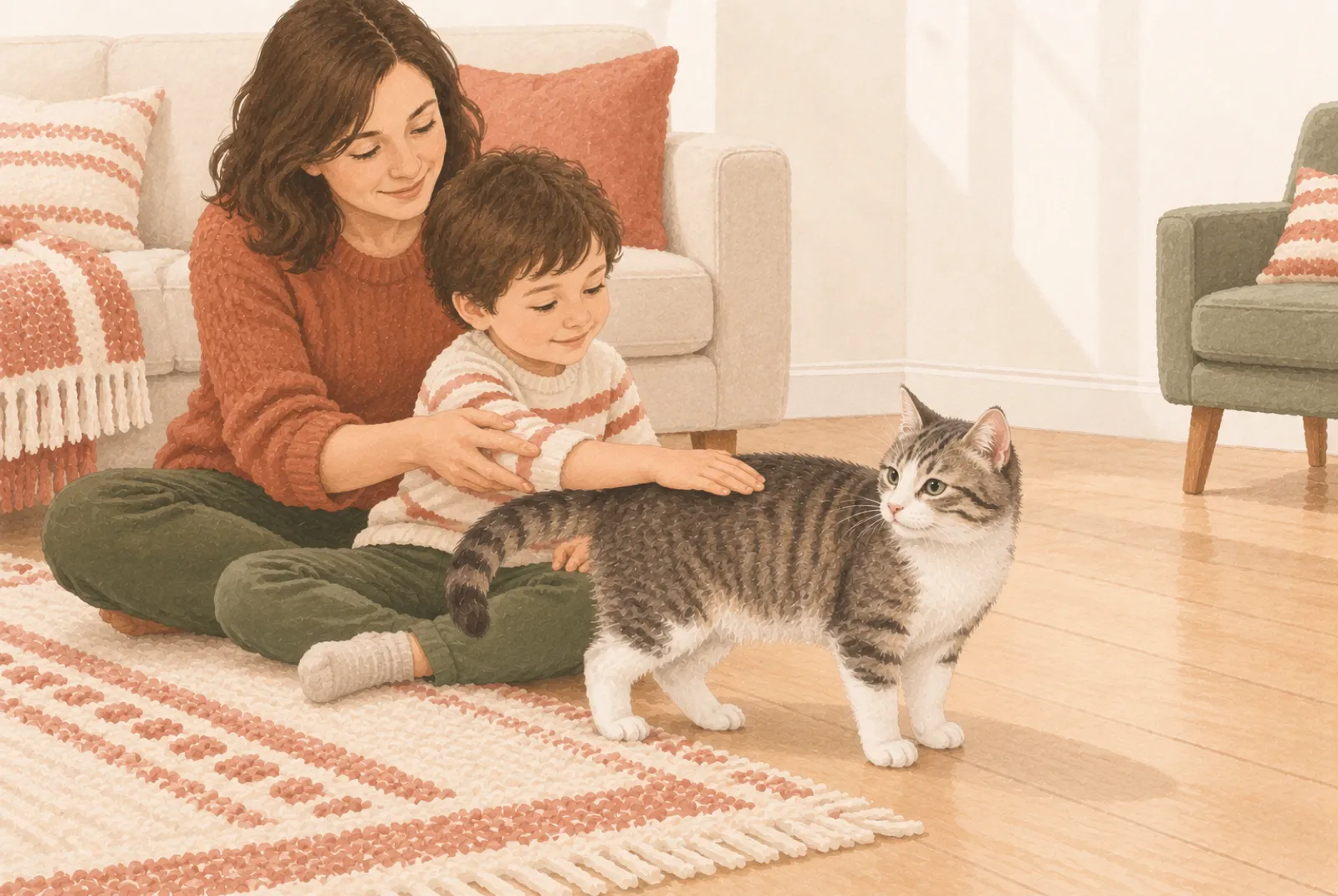
Set the rules before the first hello
The easiest rules to keep are the ones that exist before they are needed. Cats Protection recommends introducing cats and children gradually, with supervision — and a little framing helps a child understand why: the cat is smaller than them, cannot say “stop” in words, and communicates with their whole body instead.
Source: Cats Protection on cats and children.
Say the rules as things children do, not just things they must not. Sit on the floor so nobody looms. Use quiet voices. Let the cat come over. Hands stay gentle and slow. A child old enough to repeat the rules back is old enough to start learning the cat’s answers — and a younger child simply gets shorter, more supervised contact while they learn.
House rules worth writing down
- The cat comes to youChildren stay seated and let the cat close the distance.
- Gentle hands onlyStrokes along the back, never grabbing, pulling or picking up.
- No chasing, everChasing ends the game — a cat who is running is done, not playing.
- Quiet spots stay privateNobody follows a cat into their bed, hide or feeding corner.
Letting the cat approach
The fairest introduction is the one the cat starts. Cats Protection’s guidance is to let the cat approach in their own time and to make sure the cat is always free to walk away — so a child sits quietly at floor level, keeps still, and lets curiosity do the work. A cat who sniffs a knee and leaves has given you a good first meeting; a cat who stays in another room has answered too.
Source: Cats Protection on cats and children.
Keep first meetings short and quiet — a few minutes of watching beats twenty minutes of following. If the cat does not approach, that is information, not failure; the next day is another chance. For the wider settling-in pattern around a new cat, our first-days guide covers the calm version.
Showing children a gentle stroke
Show the stroke before you describe it. A slow hand, moving along the cat’s back in the direction the fur lies, from shoulder to tail — or a soft stroke on the cheek if the cat offers one. An adult hand guiding a child’s hand for the first few strokes teaches the pressure better than words can. Most cats prefer strokes in the places they would groom each other; the tummy, paws and tail are usually out of bounds even for trusted adults.
A useful habit is counting strokes together: two or three gentle strokes, then a pause, then watch the cat’s answer. If the cat stays relaxed or leans in, continue. If the cat moves away, that was the answer — stroke over. Children learn quickly that a cat who gets to leave is a cat who comes back.
Sources: Cats Protection on cats and children and Cats Protection on cat body language.
Spaces where the cat is left alone
Every cat living with children needs places where the rules are theirs alone. Cats Protection recommends giving cats a safe space they can retreat to — a quiet room, a covered bed, a high perch, or a spot behind the sofa — and it only works if children learn that a cat who goes there has clocked out. Feeding spots and litter trays carry the same protection: they are the cat’s private business.
High places matter particularly because they let the cat stay in the room and still be out of reach — a cat on a shelf can watch family life without handling it. If your cat does not yet have reliable hiding places, our hiding guide explains how to make good ones. The deeper promise underneath all of this: a cat who is never cornered learns that children are safe to be near.
Source: Cats Protection on cats and children.
Reading “enough” signals together
Cats Protection lists the signs that a cat has had enough of an interaction: moving away or hiding, ears turned sideways or back, dilated pupils, rapid tail movements, sudden grooming, lip licking — and at the harder end, hissing or swiping. Children spot these more easily than you might expect once the signs are pointed out, and spotting them together turns “the cat is cross” into “the cat has had enough”.
Reading the whole picture matters more than any single sign — a relaxed face, forward ears and an upright tail usually mean a comfortable cat, while the signs above say pause. Our body-language guide is written for exactly this and is a good page to read with an older child. One caution for the grown-ups: these cues are for guiding interaction, not for reading a mood into a cat; context and the whole body always come first.
Sources: Cats Protection on cats and children and Cats Protection on cat body language.
Scratches and when to clean or seek advice
Even a well-run household gets the occasional scratch. For a minor one, the NHS’s cuts-and-grazes guidance treats it like any small wound: stop any bleeding first with firm pressure from a clean cloth or dressing — raising an injured arm or leg helps — then rinse the wound with water, pat it dry, clean the skin around it with soap and water (wiping away from the wound so soap stays out), and cover it with a plaster or clean dressing. Get medical advice — in the UK an urgent GP appointment or the NHS’s urgent medical help service, elsewhere your doctor or local health service — if the wound is still dirty after cleaning, turns swollen, red and more painful or leaks pus, is larger than about 5cm, or comes with feeling generally unwell or a high temperature.
Sources: NHS on cuts and grazes and NHS on urgent and emergency care services.
A cat bite that breaks the skin is a different wound, and the NHS gives bites their own instructions: clean the wound with soap and warm water, gently squeeze so it bleeds slightly, press a dry dressing firmly onto it if it is bleeding heavily, then pat dry and cover. Bites carry extra reasons to get medical advice: a bite on the hands, feet, face or head, a wound that may hold teeth, hair or dirt, a bite from a person, a wound that is hot, swollen, weeping or smells unpleasant, or no tetanus vaccine in the last ten years. And for scratches and bites alike, two things skip straight to emergency care: a wound that is large or deep, and bleeding you cannot stop — in the UK that means A&E, and for a serious injury call for an ambulance rather than driving yourself; elsewhere, your local emergency service.
Sources: NHS on animal and human bites, NHS on cuts and grazes and NHS on urgent and emergency care services.
A scratch is also information about the cat. If it happened during handling, the rules probably bent somewhere — check which one. If a cat is persistently fearful, defensive or hard to settle around children despite careful introductions, that pattern deserves professional eyes: speak to your vet, who can check for pain and refer on to a qualified behaviourist if needed.
Takeaway: Write the rules before you need them, let the cat start every hello, protect the quiet places absolutely — and teach children that reading “enough” is the whole skill.
Sources and review
- Cats Protection: cats and children
- Cats Protection: cat body language
- NHS: animal and human bites
- NHS: cuts and grazes
- NHS: urgent and emergency care services
Sources last checked 2026-10-01. Sources support the statements near them; these organisations do not endorse Cat Says Hi.
Spotted an error? Tell us.
Learning to look, together
A calm photo note names the visible traits in a picture — coat, markings, posture — which makes it a gentle way to practise looking before touching. It is an AI-generated, provisional read, sent only when you select Analyze. Read the Privacy Policy for the full data-handling details.