
Caring for an older cat at home
Senior care is mostly subtraction: remove the jump, the draught, the high-sided tray, the long search for water — and what remains is a comfortable cat. This guide covers the everyday adjustments that help an ageing cat, and the changes that are worth a vet call rather than a shrug.
What typically changes with age
Cats Protection describes cats as senior from around eleven, mature from about seven, and geriatric past fifteen — though the calendar matters less than the cat. Common shifts with age include more time asleep (with lighter sleep and more waking), less jumping, changes in appetite or thirst, a coat that is groomed less thoroughly, hearing or vision changes, and sometimes new behaviour such as increased dependence or louder yowling.
Source: Cats Protection on elderly cats.
Hold two ideas together here. Cornell’s Feline Health Center points out that growing older is not a disease, and that some older cats change very little — and also that gradual health or behaviour changes should not automatically be chalked up to age, because they can be signs of conditions worth treating. Later sections are about telling those apart.
Making the home easy: access, warmth, soft landings
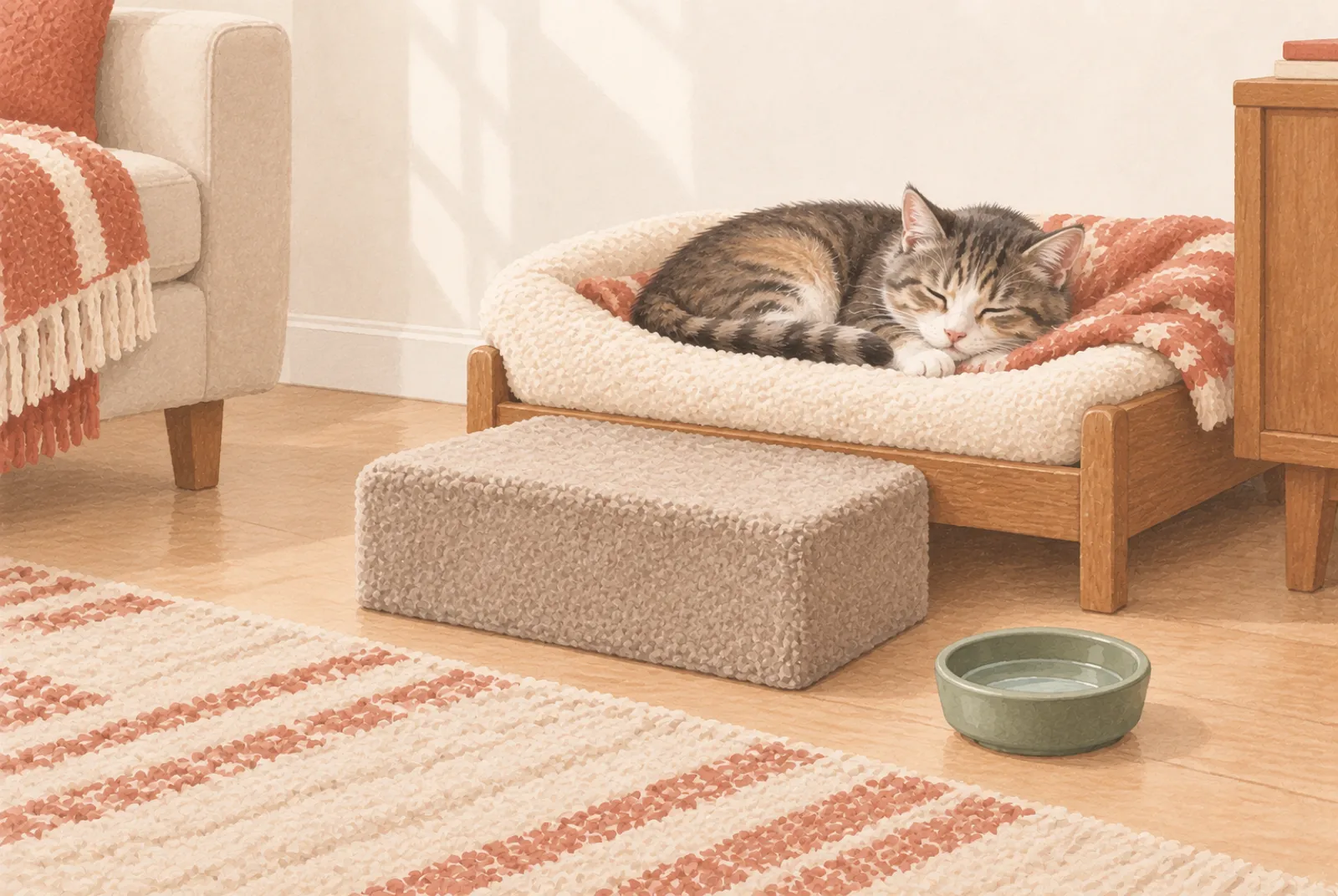
The single theme of senior care is access. Cornell’s advice is direct: older cats should have easy access to food, water and litter boxes so they do not have to climb stairs if they choose not to — which can mean bowls and trays on more than one floor, and litter boxes with low sides. Cats Protection adds the details that make a difference in a real house: ramps or stepping-stone furniture up to favourite perches with carpet or other grippy covering, cushions under windowsills as soft landings, rugs over slippery floors, and several warm, quiet sleeping spots in different places.
Warmth deserves a mention of its own. Senior cats often sleep lightly and seek warm spots; Cornell suggests keeping favourite resting places out of draughts while avoiding direct heat a slower cat cannot move away from quickly. Predictability helps too — cats appreciate routine more as they age, so serve meals at the same times and rearrange furniture only when necessary.
Sources: Cornell Feline Health Center on older cats and Cats Protection on elderly cats.
Four quiet adjustments
- Steps to favourite spotsA box, ottoman or pet stair with grip, so the windowsill stays reachable.
- Low-sided litter traysEasy to step into, on each floor the cat uses, in quiet corners.
- Essentials on one levelFood, water, tray and bed reachable without stairs.
- Warm, soft resting placesPadded beds out of draughts — warm, never hot.
Grooming help for a stiff cat
Flexibility is one of the first things age takes. A cat who once reached every spot may start to look unkempt along the back or near the tail, and long coats mat more easily. Cats Protection suggests regular gentle brushing — daily for long-haired cats, once or twice a week for short-haired ones — which doubles as a calm skin check for lumps, ticks and sore patches. A damp cloth can lift discharge at the corners of the eyes.
Keep sessions short and let the cat leave; our gentle brushing guide covers the pace. One caution matters here: an older cat may be sore in exactly the places they can no longer groom, so flinching or a sudden unkempt coat is worth noting rather than brushing through. Claws need attention too — older cats scratch less effectively, so claws can thicken and overgrow, and Cats Protection suggests a trim roughly every two to four weeks. If mats form close to the skin, ask your vet about the safest way to remove them.
Sources: Cats Protection on elderly cats and Cornell Feline Health Center on older cats.
Food, water and litter adjustments
Cats Protection advises moving to a senior food at around eleven — older cats generally need fewer calories but good-quality protein, and a vet can advise on the right diet. The threshold is not one number everywhere: the same charity’s feeding page puts the senior stage from about eight, and product labels differ again, so the food’s stage guidance and your vet’s advice settle the timing for the individual cat. For a fading appetite, small habits help: feed little and often (four to six small meals a day is a workable start), warm food gently to lift its smell, offer different textures, and put bowls in several easy-to-reach spots — even on a low raised surface so the cat bends less. Fresh water matters more than ever, in more than one place.
On the litter side: even a lifelong outdoor toileter may want indoor trays in bad weather or when neighbourhood cats feel threatening. Provide a few trays in quiet, private, easy spots — large enough to turn in, low enough to step into, with a soft litter an older cat can dig comfortably. Cornell notes some seniors will climb into a normal box to urinate but not to defecate; a tray with a genuinely low entry solves it.
Sources: Cats Protection on elderly cats, Cats Protection on feeding your cat and Cornell Feline Health Center on older cats.
Watching for real changes, not just age
Cats are skilled at hiding discomfort, so the useful skill is watching the trend rather than the day. Cornell’s “slowing down” guidance is a good example: a quieter, more sedentary cat may simply be an older cat — or may be carrying joint pain that responds to treatment, since slowed, reclusive behaviour can be a subtle sign. The honest default is to mention change, not to decide it.
Source: Cornell Feline Health Center on slowing down.
Tell your vet about any new change — do not save it for the next check-up. Weight drifting either way, eating noticeably more or less, drinking much more water, vomiting or diarrhoea that keeps returning, toileting outside the tray, new confusion or night-time yowling, unsteady back legs, drooling, and a coat that has stopped being groomed are all worth that call; Cats Protection’s elderly-care guide lists these among the signs never to ignore in an older cat. One sign cannot wait at all: a cat straining in the tray and producing little or no urine may have a blocked bladder, which Cornell describes as an emergency needing immediate veterinary treatment. Our vet-notes guide turns watching into a page of facts the clinic can use.
Sources: Cats Protection on elderly cats and Cornell Feline Health Center on urinary tract disease.
Keeping the vet in the loop
Older cats benefit from being seen more often than younger ones: Cats Protection notes many vets suggest twice-yearly checks from around seven or eight, and Cornell describes six-month check-ups for geriatric cats as ideal. Weight checks and booster vaccinations sit alongside the examination. Bring your notes — dates, amounts, what is usual for this cat — because small trends are exactly what a vet can weigh against an examination.
A calm photo habit has a modest, honest role here too: pictures taken in similar light months apart can show a coat getting duller or a silhouette slowly changing shape in a way that is hard to notice day to day. Our photo and routine-care guide covers how to take them gently. Treat photos as one input for a conversation — never a way to decide something is fine.
Takeaway: Remove the daily obstacles, groom gently, watch the slow trends — and let the vet decide which changes are age and which are treatable.
Sources and review
- Cornell Feline Health Center: loving care for older cats
- Cats Protection: elderly cats
- Cats Protection: feeding your cat
- Cornell Feline Health Center: is your cat slowing down?
- Cornell Feline Health Center: feline lower urinary tract disease
Sources last checked 2026-10-01. Sources support the statements near them; these organisations do not endorse Cat Says Hi.
Spotted an error? Tell us.
Watching slow change gently
A calm photo note returns an AI-generated, provisional read of a cat’s coat, markings and posture, with everyday care ideas to go with them. Nothing is sent until you select Analyze, and it is never a health check. Read the Privacy Policy for the full data-handling details.