
Checking a cat’s shape at home: a gentle body-condition look
A hands-on way to look at a cat’s waist, ribs and silhouette, how a photo can help you compare over months, and what only a vet can weigh up.
Why shape matters more than a number
“What should my cat weigh?” has no single answer — it depends on the cat’s frame, age and breed, which is why vets lean on body condition rather than the scales alone. Body condition scoring is a structured look-and-feel assessment of a cat’s fat stores: instead of asking whether the number is right, it asks what the body is actually like. The World Small Animal Veterinary Association includes a cat body-condition chart in its nutrition toolkit — a nine-point scale where five is the ideal — so the idea you are practising at home is the same shape vets use in the clinic, just without the score.
Sources: WSAVA Global Nutrition Guidelines and the WSAVA cat condition chart (PDF).
For scale, International Cat Care describes a cat as overweight at roughly 10–19% above their ideal body weight, and obese at 20% or more. Those thresholds are for the vet’s record, not your eyes — at home, the useful job is noticing which direction the shape is drifting, and that is what the next three checks are for.
The three views: from above, the side, a gentle rib feel
Do this while the cat is standing or moving naturally — a stretched-out flop hides the shape you are looking for. You are reading three things, and none of them asks you to name a score.
The home body-condition look
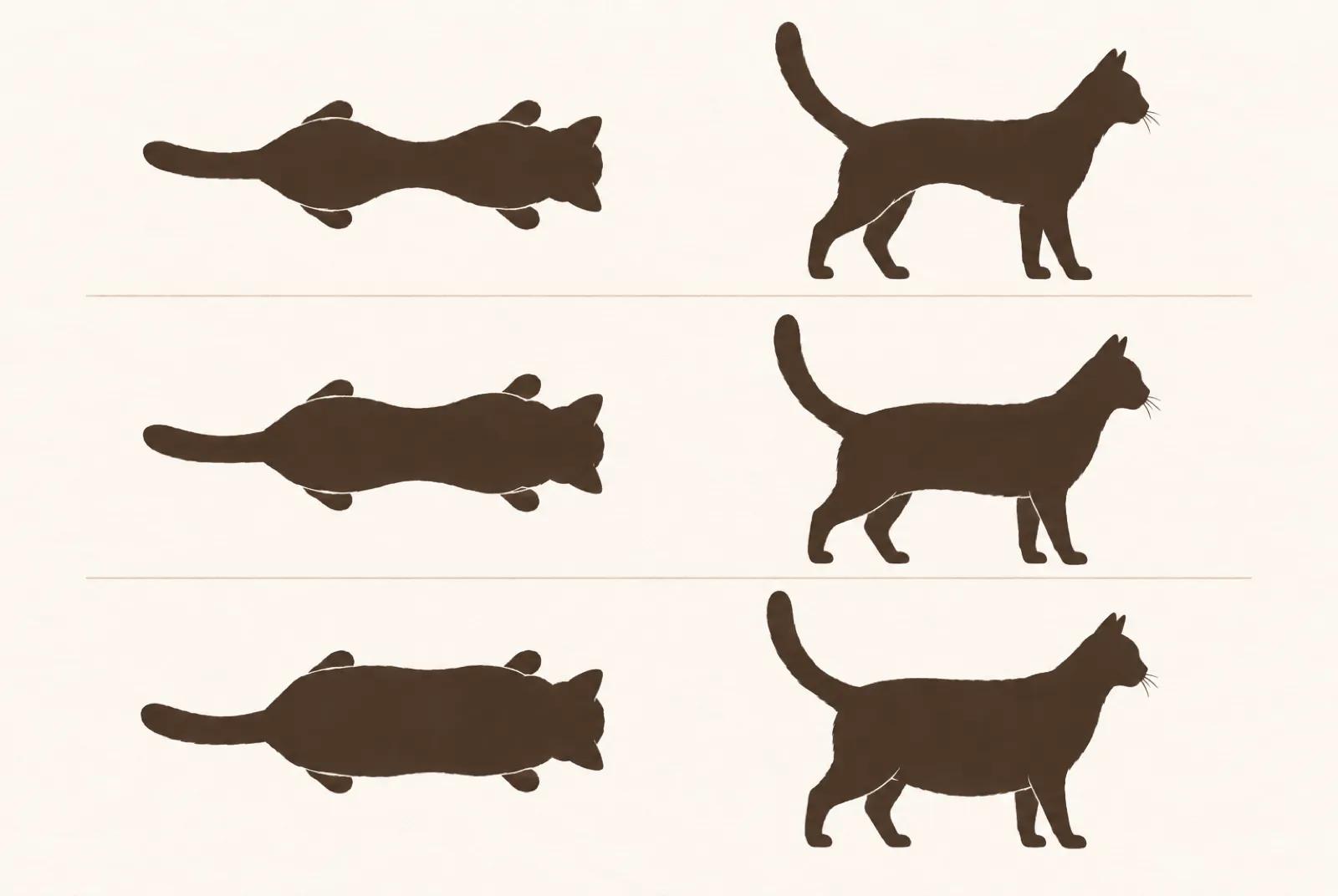
- From aboveLook down over the standing cat. Behind the ribs, does the outline narrow into a waist, or run straight — or wider?
- From the sideLook for a slight upward tuck of the belly behind the ribs, rather than a straight or hanging line.
- Along the ribsRest a flat hand on the ribcage. Can you feel the ribs under a thin covering, easily, or hardly at all?
What “ideal” tends to look like: ribs you can feel under a slight covering of fat, a waist visible behind the ribs from above, and a small tummy tuck from the side with little abdominal fat. In a heavier cat the ribs become hard to feel, the waist disappears from above, and the belly can hang as a pendulous “skirt”; International Cat Care describes that rounded profile — along with fat deposits on the face and neck — in its account of an obese cat. At the lean end, the WSAVA chart describes ribs that are easily seen on a shorthaired cat and a pronounced tuck, with little fat to feel.
Sources: International Cat Care on obesity in cats and the WSAVA cat condition chart (PDF).
Treat what you find as a note, not a verdict. Long fur hides ribs and waists generously — which is why the gentle rib feel exists — and “harder to see a waist than last year” is a more useful observation than “definitely obese”. If the shape is drifting in either direction, that observation is worth bringing to a vet rather than acting on alone.
Using a photo to compare over months
Gradual change is the enemy of memory: a shape that creeps over six months looks normal to eyes that see it daily. A photo every month or two — from directly above while the cat stands, and square-on from the side — gives you something memory cannot: the same view, comparable. Our calm photo guide covers getting those pictures without pestering the cat.
Be honest about what a photo is. It records silhouette and posture in a moment — useful for comparison — but it cannot weigh, feel, or tell you why a shape changed. The same honesty applies to photo tools: a Cat Says Hi result is an AI-generated, provisional read — it describes visible traits such as coat and posture and offers everyday care ideas; it does not assess weight or health, and it never will. Describing what you see in your own words — “waist less visible than in spring”, rather than a label — pairs well with the habits in our vet-visit notes guide.
What a vet weighs in addition
A vet brings the things a look cannot supply: a scale weight against that cat’s own history, hands-on palpation, and a muscle condition score — a separate assessment the WSAVA toolkit includes alongside fat scoring, because muscle changes with age and illness in ways fat does not show. They also bring context: a rounder shape in a cat whose records show years of stable weight is a different conversation from a rounder shape that arrived in six months.
Source: WSAVA Global Nutrition Guidelines.
And they can check for what the shape might be shadowing. Weight gain can travel with reduced mobility or an underlying condition; unexplained weight loss — even in a cat who seems otherwise fine — deserves prompt attention rather than applause. This is where a home look earns its keep: it is an early-warning habit that feeds a better conversation, not a substitute for one.
Making small changes safely
If your look suggests the cat is carrying more than they used to, resist the dramatic response. International Cat Care cautions against cutting food suddenly or sharply — sudden restriction can make a cat unwell — and recommends working out a realistic plan with your vet first. The boring, effective starting point is accuracy: weigh out the daily food allowance rather than topping up the bowl, since dry food especially is easy to over-serve.
Source: International Cat Care on obesity in cats.
Activity is the gentler lever — short, regular play sessions suit cats far better than weekend boot-camp ambitions, and our play guide has low-pressure ways to start. Treats count towards the day’s total too; our feeding and water routine guide covers keeping them proportionate. And keep the target honest: the RSPCA notes that how much a cat needs depends on their age, lifestyle and health — the pack’s feeding guide is a starting point you adjust to the cat in front of you, ideally with your vet’s input. Whatever changes you make, if the cat’s shape or appetite is shifting without explanation, skip the self-experiment and book the vet — that is the one move with no downside.
Source: RSPCA on cat diet.
Takeaway: Look from above, look from the side, feel the ribs — and let the vet turn your notes into a plan.
Sources and review
- WSAVA: global nutrition guidelines
- WSAVA: cat body condition score chart (PDF)
- International Cat Care: obesity in cats
- RSPCA: cat diet
Sources last checked 2026-10-01. Sources support the statements near them; these organisations do not endorse Cat Says Hi.
Spotted an error? Tell us.
A photo for the record
A photo taken from above and the side makes month-to-month comparison possible. The result is an AI-generated, provisional read of visible traits and everyday care ideas — never a health judgement. Nothing is sent until you select Analyze. Read the Privacy Policy for the full data-handling details.