
Shedding seasons: what’s normal and what deserves a second look
Why cats shed, why indoor cats often shed all year, why some coats drop more visible fur, and the skin signs that belong with a vet rather than a brush.
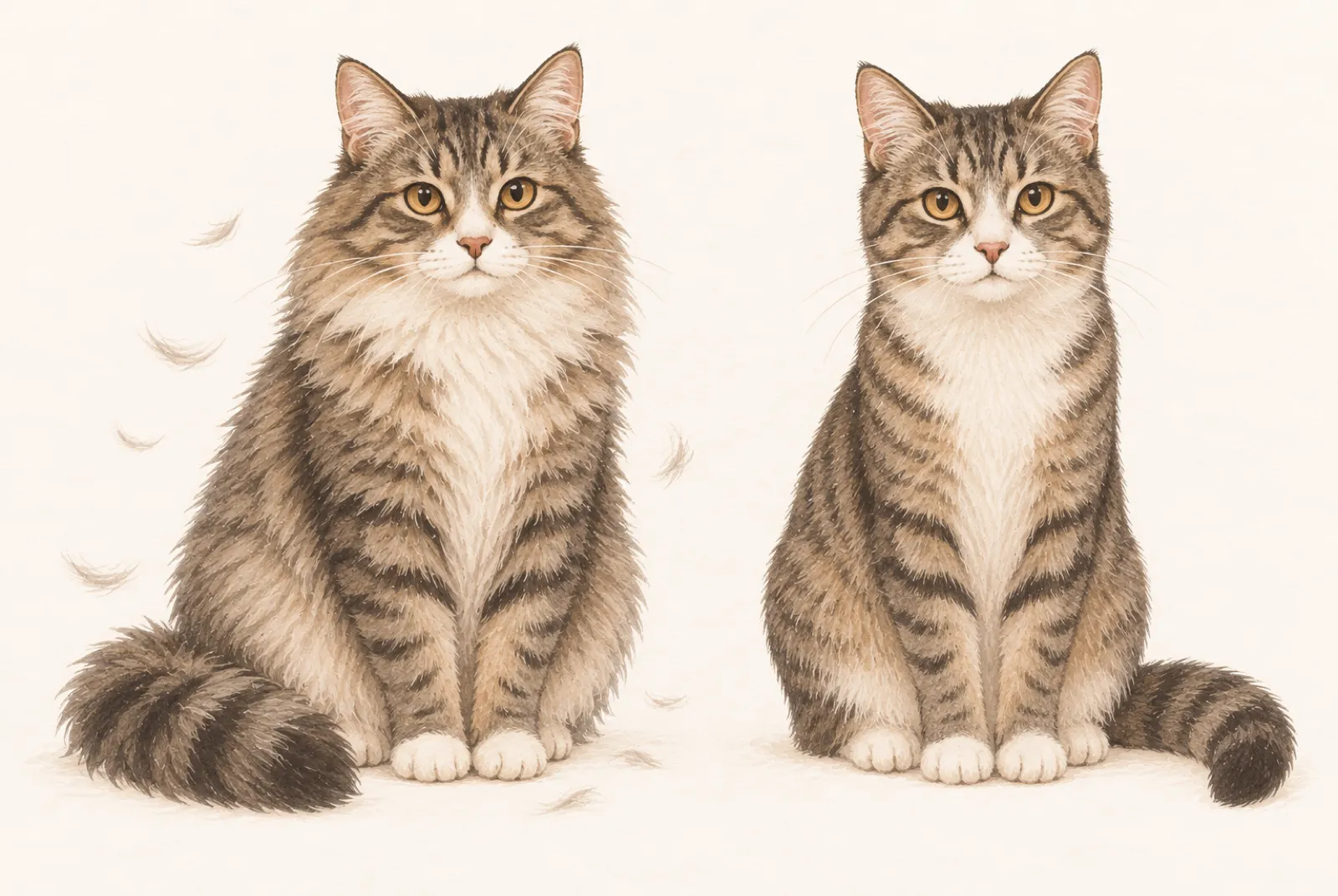
The coat’s growth cycle in plain terms
A cat’s coat is not a fixed jacket — it is a field in constant slow motion. Hairs grow, rest and fall out in a rolling cycle, which is why International Cat Care says cats usually moult throughout the year to some degree. The coat itself has two working layers: longer guard hairs on the outside, and a soft, dense undercoat underneath that provides insulation. Shedding is how the old layer leaves to make room for the new.
Sources: International Cat Care on grooming and VCA Animal Hospitals on coat care.
Some of that shed hair doesn’t reach the floor at all — the cat’s own grooming swallows it, which is where hairballs come from. So the fur on your jumper is only the share that escaped the cat’s own housekeeping.
Source: International Cat Care on grooming.
Spring and autumn versus indoor year-round shedding
For cats who live close to the seasons — particularly outdoor cats in cooler climates — VCA describes two heavy shedding periods a year, in late spring and late autumn, when the undercoat comes out in clumps as the coat is swapped for the weather ahead. That is the classic “blowing the coat” moment: a lot of fur, on a schedule, and entirely ordinary.
Source: VCA Animal Hospitals on coat care.
Indoor cats read a different calendar. VCA notes that cats who share our homes often shed undercoat and guard hairs at low levels all year round; Cats Protection attributes the flatter pattern to indoor cats being less exposed to the natural light cycles and seasonal temperature changes that trigger coat swaps. So finding fur in midsummer is not, by itself, a red flag. What matters is the pattern against your own cat’s normal: a steady sprinkling is just an indoor coat doing its job.
Sources: VCA Animal Hospitals on coat care and Cats Protection on why cats shed.
A useful mental model: seasonal sheds announce themselves — the undercoat coming away in visible clumps, a fluffier feel at the brush, a clear start and end. Year-round shedding is quieter: loose hair at a low, steady level with no dramatic turn. A cat who breaks their own pattern — shedding suddenly doubling outside a season, or arriving alongside itching — has moved out of “just moulting” territory, and the final section covers where that boundary sits.
Coat type and apparent volume
How much fur you find is partly a property of the coat, not the cat’s health. VCA points out that some cats shed very little — Sphynx and Rex types being the obvious examples — while others, like Maine Coons, shed noticeably. And long or dense coats simply make the same turnover look bigger: the fur is longer, looser and far more visible on dark clothes.
Source: VCA Animal Hospitals on coat care.
If you want the vocabulary for the coat you are seeing, our coat glossary covers length and pattern terms, and the coat-and-breed-clues guide explains what appearance can and cannot tell you. Neither changes the shedding arithmetic: volume on the sofa is a coat statistic, not a health score.
Keeping loose fur manageable
Brushing is the practical answer, and it earns its keep twice: it removes loose hair before it reaches the sofa or the cat’s stomach — meaning fewer hairballs — and it gives you a regular close look at the coat and skin underneath. International Cat Care notes that long-haired cats need grooming at least daily to prevent knots; VCA says long, silky or curly coats benefit from daily brushing, while short-haired cats usually need less. Our brushing guide covers the technique — start short, let the cat set the pace.
Sources: International Cat Care on grooming and VCA Animal Hospitals on coat care.
While you brush, the coat gives you information for free: run a comb through and watch for tangles, debris, or the dark comma-shaped specks of flea dirt that iCatCare suggests checking for. Grooming is also the moment a skin problem tends to surface early — iCatCare treats the session as a chance to look over the skin, not just the hair. If the cat hates the brush, stop rather than pushing through; a stressed cat learns the tool, not the routine.
Source: International Cat Care on grooming.
Ordinary shed versus worth a call
Probably just shedding
Loose fur everywhere but the coat looks complete; skin calm under the hair; volume rises and falls with the seasons or stays gently constant indoors.
Deserves a vet call
Bald areas, sore or flaky skin, bumps, redness, or a cat suddenly licking or scratching the same spot over and over.
The difference is the skin and the pattern: shed fur leaves a full coat behind; a problem usually leaves a mark.
Bald patches, sore skin and over-grooming: see the vet
Shedding explains loose fur; it does not explain bare skin. Cornell’s Feline Health Center lists excessive scratching, licking or chewing at the fur, redness or swelling, loss of fur, scabby or scaly skin and raised bumps among the signs of skin disease — a different category entirely, with causes that range from parasites to allergies. Identifying which one applies takes a clinical history and an examination; it is not something a brush, a photo or this guide can sort out.
Source: Cornell Feline Health Center on feline skin diseases.
Over-grooming deserves the same boundary. A cat licking one area raw is not “shedding more from that spot” — it is a behaviour or skin question for a vet, and Cornell’s skin guidance makes clear how many different causes can sit behind it. If you are tracking what you have noticed, our vet-visit notes guide shows how to describe it usefully for the appointment.
Takeaway: Fur on the furniture is the coat doing its job; fur leaving bare skin behind is the vet’s job.
Sources and review
- VCA Animal Hospitals: grooming and coat care for your cat
- International Cat Care: grooming your cat
- Cats Protection: why do cats shed their fur
- Cornell Feline Health Center: feline skin diseases
Sources last checked 2026-10-01. Sources support the statements near them; these organisations do not endorse Cat Says Hi.
Spotted an error? Tell us.
Track the coat, not the worry
A photo now and then gives you a dated record of how the coat actually looks, so change is easier to describe. The result is an AI-generated, provisional read of visible traits — nothing is sent until you select Analyze, and it is never a diagnosis. Read the Privacy Policy for the full data-handling details.