
Cat coat colours and patterns: a plain-language glossary
Plain-language meanings for everyday coat words — tabby, tortoiseshell, calico, tuxedo, colourpoint and dilute — and what they cannot tell you.
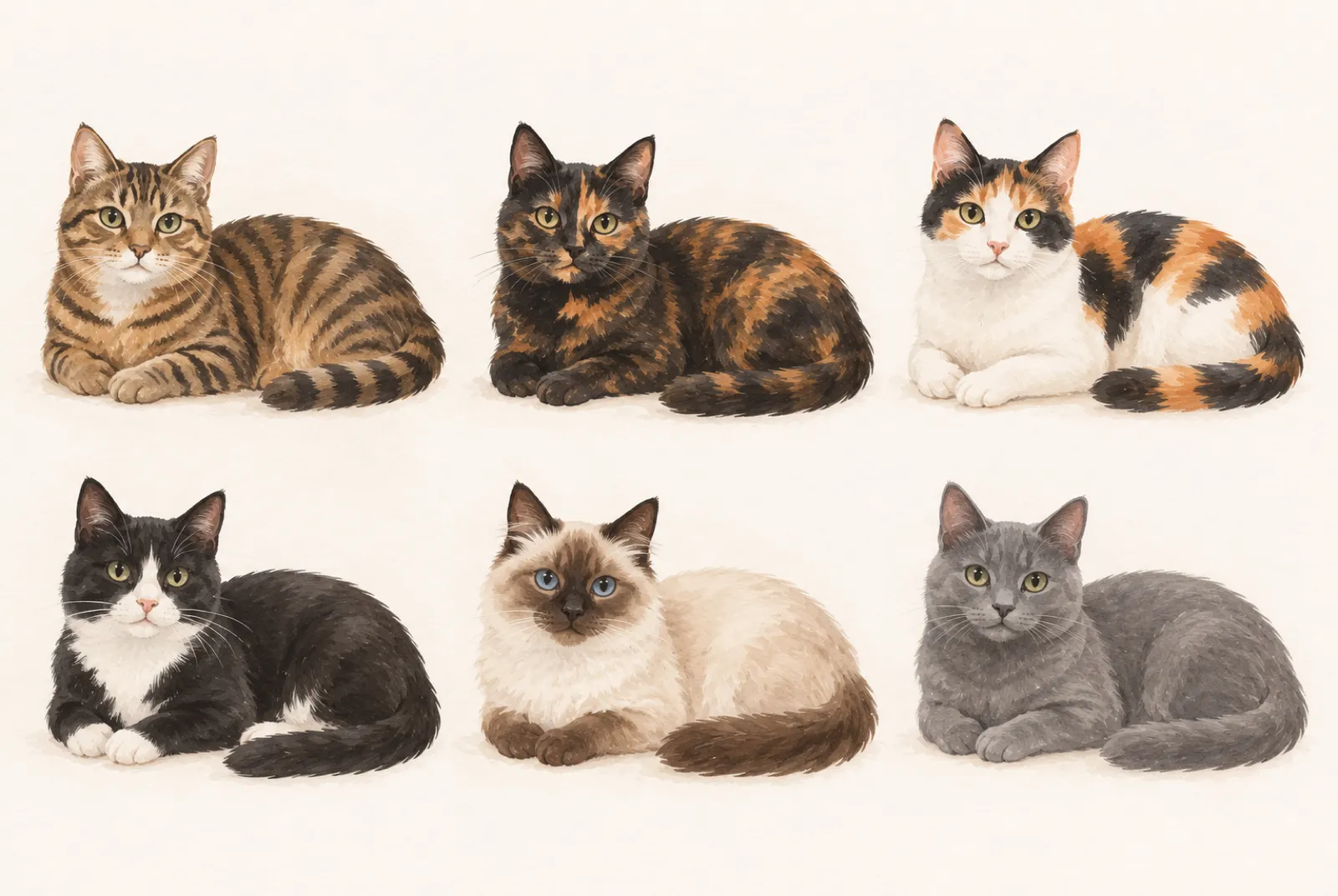
How to use this glossary
These are everyday words for what a coat looks like. You will meet them in adoption listings, vet notes, breed write-ups — and in photo results like ours, which describe visible traits in plain language. Each entry gives you enough to use the word correctly and to recognise when it is being stretched into a claim it cannot support.
The terms are descriptive shorthand, not official categories. Different writers draw the boundaries slightly differently, and the same coat can reasonably be described with more than one word. If you want help forming a careful description from a photo, our coat patterns and breed clues guide walks through the method.
Source: Cats Protection on cat colours.
Pattern words: the tabby family
Tabby is not a breed — it is the family of coat patterns built from stripes and markings. Cats Protection notes that the original cat coat is the striped tabby, and that every cat carries tabby heritage; a solid-colour gene can hide the pattern, which sometimes still ghosts through on kittens.
Source: Cats Protection on cat colours.
Mackerel tabby
Narrow, parallel stripes running down the sides from the spine — sometimes called a “tiger” pattern in conversation. This is the oldest and most common arrangement.
Classic (blotched) tabby
Broad, swirling bands — often a bullseye or oyster shape on each flank — instead of thin stripes. Also called a blotched tabby.
Spotted tabby
Stripes broken into spots or dashes across the body. The spots can be large and round or small and fleck-like.
Ticked tabby
Each hair carries bands of colour, so the coat looks evenly speckled from a distance, with tabby striping often surviving only on the legs, tail and face.
The same words on real coats
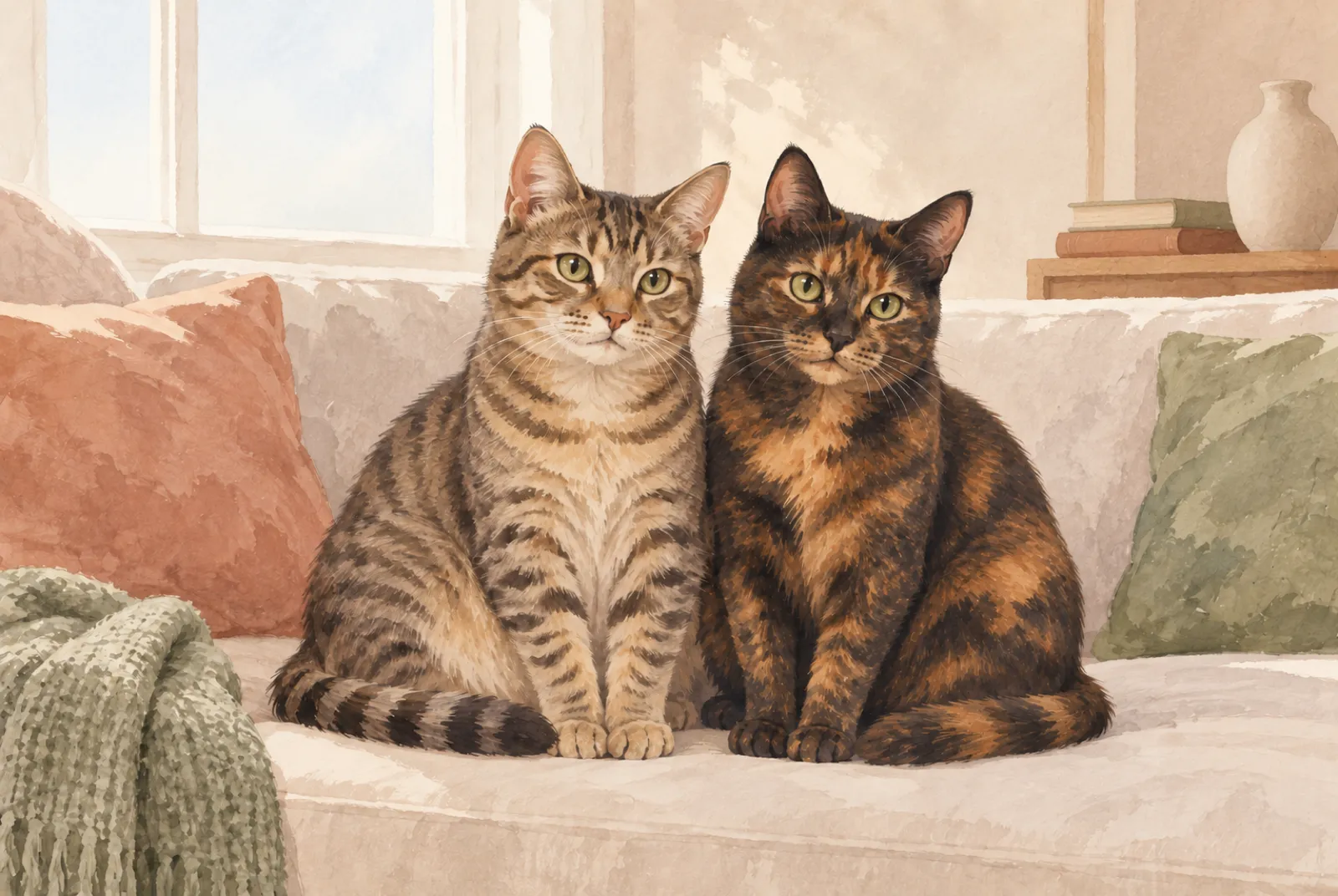
Mackerel tabbyNarrow, even stripes running down the flank from the spine.
TortoiseshellBlack and orange mingled together with little or no white.
A tabby description pairs with a colour: “brown tabby”, “grey tabby”, “ginger tabby”. The pattern word tells you the arrangement; the colour word tells you the palette.
Colour mixes: tortoiseshell, calico, torbie
Tortoiseshell (often shortened to “tortie”) describes a coat where black and orange are mingled or interwoven, usually with little or no white. Calico describes the same colour pair appearing in larger, more separate patches, typically on a mostly white coat. Usage varies between regions and writers, so the two words overlap at the edges — a photo of the actual cat settles questions better than a label.
These mixed coats are nearly always seen on female cats. Cats Protection explains that the orange colour is carried on the X chromosome, so a female’s two X chromosomes allow orange and non-orange to appear together; a male would need the rare extra-chromosome combination to show the same mix.
Source: Cats Protection on cat colours.
Torbie is the blended word for a tortoiseshell-patterned cat whose coloured patches also carry tabby striping — a “tortoiseshell tabby”. You may also see dilute tortie or dilute calico, where the black and orange are softened to grey and cream.
White-spotting words: tuxedo, bicolour, van
These words describe how much white a coat carries and where it sits. Tuxedo is the informal term for a black (or dark) coat with white chest, paws and often facial markings — the “evening suit” look. Bicolour covers any two-colour coat where white is a substantial part, from a few white paws to a half-white coat.
Van describes a mostly white cat whose colour is concentrated on the head and tail. Piebald and parti-coloured are older words for white-patched coats. None of these words names a breed: tuxedo cats, for example, appear across pedigrees and non-pedigrees alike.
Writers sometimes grade white spotting informally as low, medium or high, but there is no single universal scale — describing what you actually see (“white chest and front paws”) is clearer than a grade.
Pointed and dilute coats
Colourpoint (or “pointed”) describes a pale body with darker colour on the cooler extremities — the face, ears, legs and tail. It is the pattern associated with Siamese-type coats, and a pointed cat’s points may themselves be solid, tabby or tortoiseshell. Kittens with this pattern are often born pale and darken with age.
Dilute describes a softened version of a colour: black becomes “blue” (grey), orange becomes “cream”, chocolate becomes “lilac”. So a “blue cream” cat is a dilute tortoiseshell — grey and cream where a tortie would carry black and orange.
You may also meet smoke and shaded, where the hair is pale near the root and coloured at the tip, and solid or self, meaning one even colour across the coat.
What these words cannot tell you
Coat vocabulary describes appearance only. A tabby pattern does not make a cat a particular breed, a tortoiseshell is a colour arrangement rather than a breed, and “looks like a Siamese” describes points, not parentage. Most cats are not a documented breed at all — our guide to “what breed is my cat?” explains where pedigree fits in.
Coat words also say nothing about health or temperament. Colour-linked traits do exist at the genetics level — Cats Protection notes, for example, that congenital deafness occurs predominantly in white cats — but that is a population-level observation, not something you can conclude about an individual cat from a photo. Behaviour, appetite and comfort are far better everyday signals, and changes there belong with a veterinarian.
Source: Cats Protection on cat colours.
Where breed registries use these terms
Breed registries keep formal standards that describe each recognised breed, and coat colour and pattern terms appear inside those standards — “blue classic tabby”, “seal point”, and so on. The Cat Fanciers’ Association, for example, lists recognised breeds and their accepted colour descriptions. Reading a standard can tell you whether a coat you see is typical of a breed’s look — but matching a look is not the same as holding a pedigree, which rests on registration and parentage records.
Sources: The Cat Fanciers’ Association breeds list and Cats Protection on pedigree cats.
Takeaway: Use coat words to describe what you see; let pedigree and health stay with records and professionals.
Sources and review
- Cats Protection: why cats come in different colours
- The Cat Fanciers’ Association: breeds
- Cats Protection: getting a pedigree cat
Sources last checked 2026-09-29. Sources support the statements near them; these organisations do not endorse Cat Says Hi.
Spotted an error? Tell us.
Meet these words in a real result
Add a cat photo and the result describes the visible coat in plain language — you can read it with this glossary in hand. Nothing is sent until you select Analyze, and the result is not a diagnosis or a breed certificate. Read the Privacy Policy for the full data-handling details.