
What breed is my cat? Pedigree, domestic shorthair and honest uncertainty
What you can and cannot conclude about a cat without papers: what pedigree means, why most cats are domestic shorthairs, and how to read a possible-breed cue.
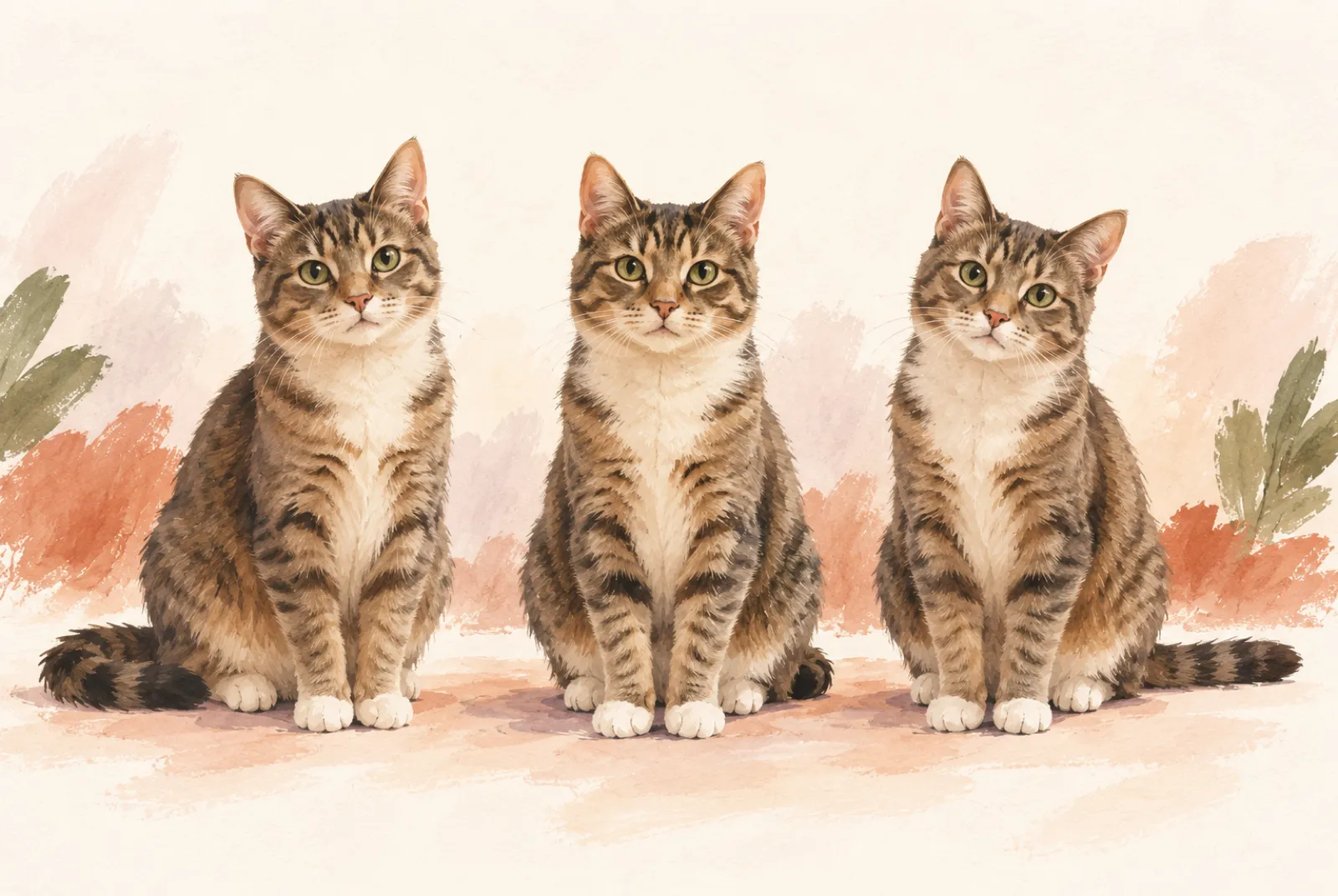
Most cats are not a breed
If you adopted your cat from a shelter, found them, or took them in without paperwork, the honest answer is usually “domestic” rather than a breed name. Unlike dogs, most pet cats descend from generations of natural mating rather than planned breeding toward a written standard. Cats Protection describes the difference plainly: pedigrees are bred from specific cats to meet breed standards, while non-pedigree cats — sometimes called moggies — come from a wide gene pool and arrive in every coat colour and length.
Source: Cats Protection on pedigree cats.
That is not a lesser category. A domestic cat is a full answer, not a placeholder waiting for a fancier one. When the AVMA talks through choosing a cat, the questions it puts first — which pet best suits your family, home and lifestyle — apply to cats of any ancestry, and none of them requires a breed label to answer.
Source: American Veterinary Medical Association on selecting a pet cat.
What a pedigree actually is
A pedigree is paperwork, not a look. For a cat to be classed as pedigree, they need to be registered with a breed association — Cats Protection names the Governing Council of the Cat Fancy (GCCF), Felis Britannica and The International Cat Association (TICA) as examples — and the certificate records the cat’s parentage. Breed registries such as The Cat Fanciers’ Association publish the list of recognised breeds and the written standards each one is judged against.
Sources: Cats Protection on pedigree cats and the Cat Fanciers’ Association breeds list.
So “pedigree” describes a documented line, and “purebred” is often used alongside it for the same idea. A cat can look exactly like a named breed and still be, in every documentable sense, a domestic cat — the resemblance is real, but the category lives in the records.
Domestic short, medium and longhair
“Domestic shorthair” is the label shelters and vets commonly use for a cat of unknown or mixed ancestry with a short coat; “domestic mediumhair” and “domestic longhair” do the same for longer coats. These labels describe coat length, not a breed family — there is no domestic shorthair registry or standard.
That means two domestic shorthairs can be as different from each other as either is from a named breed. The label is a truthful starting category: it says the cat’s appearance comes from the broad shared pool rather than a documented line.
Three honest labels for similar cats
Documented pedigree
Registration papers from a breed association record the cat’s parentage.
Possible breed cue
Appearance resembles a breed — a prompt to learn more, not a conclusion.
Unknown parentage: the everyday default — a domestic cat whose line is simply not recorded.
Why a photo can only suggest
A photograph shows coat, build and posture in one moment. Some traits really do appear more often in some breeds — a colourpoint coat in Siamese lines, for example — so appearance is not meaningless. But the shared gene pool means the same looks arise in cats with no pedigree history at all, and angle, lighting, age and condition all shift how a cat reads on camera.
Our coat patterns and breed clues guide covers what a photo can usefully describe, and the coat glossary defines the words those descriptions use. Neither can turn resemblance into parentage.
What a possible-breed cue is for
When the Cat Says Hi result lists a possible breed cue, it is saying the photo contains traits often associated with that breed — nothing more. Treat it as a search starting point: look up the breed’s standard, compare honestly, and let it stay a possibility unless records say otherwise.
It is not a reason to change feeding, grooming or care plans, and it is not evidence to rely on when buying, insuring or making health decisions for a cat. For that, records and professionals carry the weight a photo cannot.
Where DNA tests can help — and their limits
Consumer DNA tests for cats compare your cat’s markers against a reference panel and report which populations or breed-associated markers they resemble. They can satisfy curiosity and sometimes flag ancestry worth a conversation with your vet. Their limits are real too: panels and methods vary between providers, so results can differ, and a percentage is a statistical association rather than a pedigree.
Any health-related finding from a test should be interpreted with a veterinarian rather than acted on alone — the AVMA’s cat-selection guidance notes that veterinarians can provide valuable information even before a cat comes home.
Source: American Veterinary Medical Association on selecting a pet cat.
When records matter more than looks
If breed genuinely matters to you — because you are buying a kitten, because paperwork was promised, or because a record was lost — ask for the documentation rather than the description. A breeder or rescue should be able to show registration papers for a pedigree cat, and registries issue the certificates that prove parentage. A microchip and vaccination record can also fill in a cat’s history where breed questions do not.
For the cat already asleep on your sofa, the practical answer rarely changes: feed for the cat in front of you, groom for the coat you can see, and let “probably part everything” be as good an answer as any name.
Source: Cats Protection on pedigree cats.
Takeaway: “Domestic shorthair” is a complete answer. Enjoy the possible cues, and let records — not resemblance — settle breed.
Sources and review
- The Cat Fanciers’ Association: breeds
- Cats Protection: getting a pedigree cat
- American Veterinary Medical Association: selecting a pet cat
Sources last checked 2026-09-30. Sources support the statements near them; these organisations do not endorse Cat Says Hi.
Spotted an error? Tell us.
See what a photo can suggest
Add a cat photo and the result lists visible traits and possible breed cues — labelled as possibilities, never a certificate. Nothing is sent until you select Analyze. Read the Privacy Policy for the full data-handling details.