
Indoor-only or outdoors too? Weighing the everyday trade-offs
Neither arrangement is automatically right. Outdoor access gives a cat a bigger, wilder world with real hazards; indoor life trades those hazards for a promise that you will supply the stimulation yourself. Here is the honest ledger for both, the middle paths between them, and how to decide for the cat in front of you.
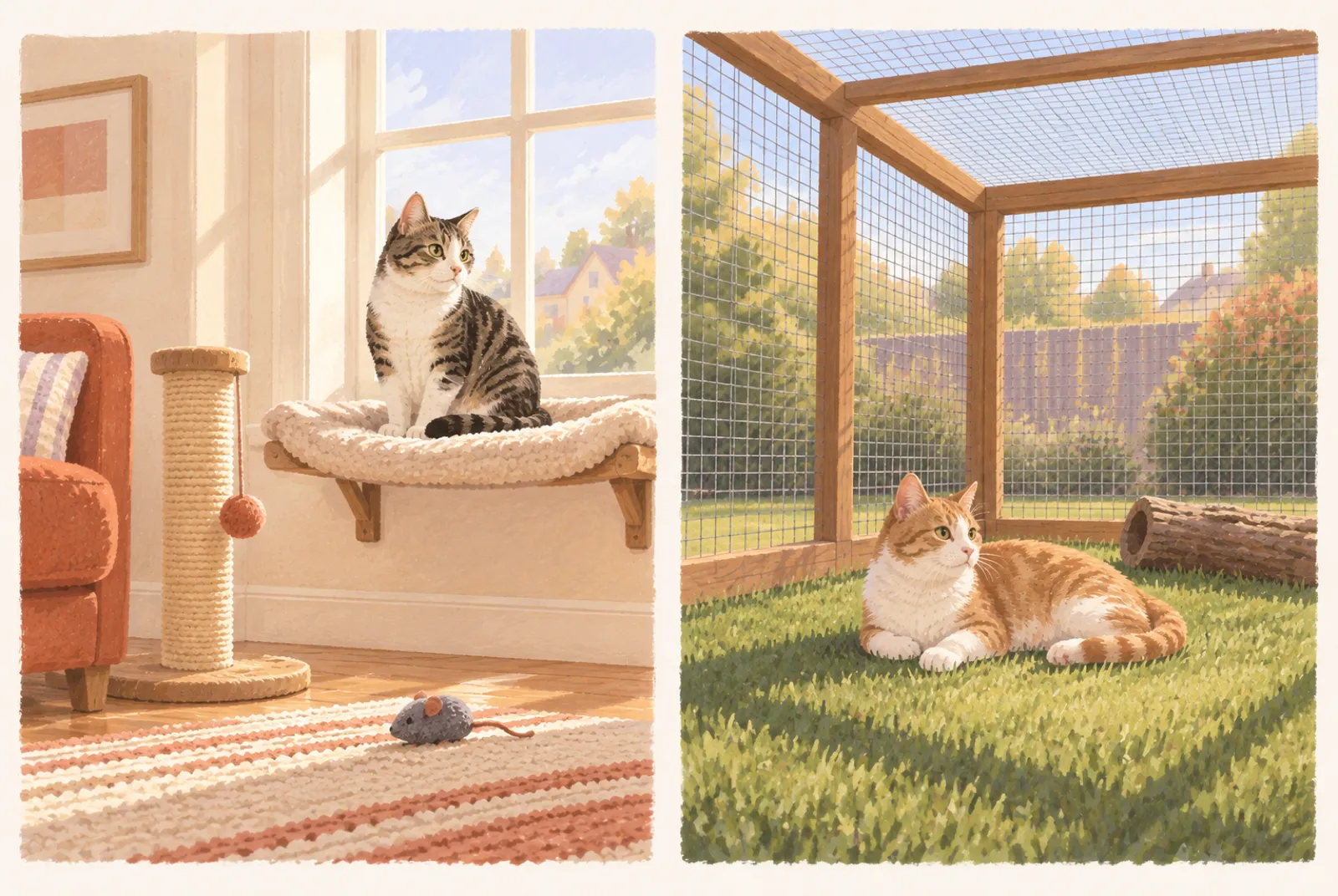
- Cats are individuals — some barely put a paw outside; the right answer belongs to your cat and your street, not a rule.
- Outdoor access trades safety for stimulation; indoor-only trades stimulation for safety — both sides need managing.
- Enclosed gardens, supervised outings and rich indoor setups sit between the two poles.
What each life asks of the cat — and of you
Cats Protection opens its indoor-and-outdoor guidance with the right starting point: cats are individuals. Some love going outside; some barely put a paw past the door; some cannot go out at all. Whatever arrangement you land on, the job is the same — keep them safe and give them a good quality of life in their home environment.
Source: Cats Protection indoor and outdoor cats guide (PDF).
Each side of the choice asks something different. Outdoor access asks the cat to navigate roads, other animals and weather — and asks you to manage the risks that come back through the flap. Indoor-only asks nothing of the cat’s street skills but everything of yours: the home has to supply the territory, the hunting, the climbing and the novelty that the outdoors provides automatically. That is the real trade, and it is why the honest question is not “which is better?” but “which can I actually provide well?”
Safety trade-offs, honestly
Outdoor risks, named plainly: roads — Cats Protection notes many injuries happen at night, and that quiet country roads can catch a cat off guard as easily as busy ones — fights with other cats or dogs, infectious disease passed between cats, parasites, getting lost or shut into sheds and garages, and outdoor poisons including slug pellets, garden chemicals, anti-freeze and rodent bait. The ASPCA’s general care guidance takes a firmer line still, recommending cats be kept indoors entirely.
Sources: Cats Protection indoor and outdoor cats guide (PDF) and ASPCA general cat care.
Indoor risks are quieter but real. A cat with no outlet for hunting behaviour may develop problem behaviours or put on weight; boredom and frustration are stress, and stress has its own physical costs — our guide to a hiding cat covers what that can look like. Cats Protection notes that some cats adapt well to indoor life, particularly if used to it from a young age, but that opportunities to play and express hunting behaviour must still be given. Neither arrangement is safe-by-default; each shifts where the work falls.
Source: Cats Protection indoor and outdoor cats guide (PDF).
Indoor cats: meeting needs indoors
An indoor cat’s world is what you build it. The RSPCA’s environment guidance lists the essentials any cat needs: a comfortable quiet bed, a toileting area away from food and sleeping spots, hiding places, toys and space to play, and high places — and notes that indoor cats need more entertainment since the environment provides less novelty on its own.
Source: RSPCA on a suitable cat environment.
Translated into a home: perches and climbing routes (a cat tree or cleared shelves give height); hiding spots (our hiding guide explains why they matter); daily play that lets the cat stalk, chase and catch — the hunt, miniatured — and scratching posts so scratching has a legal outlet; our play guide and scratching guide cover both. Ohio State University’s Indoor Pet Initiative is built entirely around this: refuge areas, elevated resting spots, prey-appropriate toys and predictable routines are what make indoor life work rather than merely contain a cat.
Source: Ohio State University Indoor Pet Initiative on indoor cats.
Outdoor cats: reducing the risk
If the cat goes out, the sensible moves are the mundane ones. Cats Protection recommends cats be microchipped, neutered and vaccinated whatever their lifestyle — in England, microchipping is a legal requirement — and a microchip is what reunites you if the cat is handed to a charity or shelter as a stray. Keeping the cat in at night removes the hours when road injuries are most common. A secure microchip-recognising flap stops neighbouring cats entering the house; a quick-release collar is the only safe collar, since anything that can snag needs to give way.
Source: Cats Protection indoor and outdoor cats guide (PDF).
The garden itself can be part of the offer. Cats Protection suggests giving the cat their own outdoor toileting spot in a secluded, sheltered patch of well-dug soil, shady hiding places, and discouraging other cats from entering — a confident home territory shrinks roaming range. For a cat new to the outdoors or a new house, the RSPCA advises starting with short, supervised sessions and building up gradually — and keeping a newly moved cat indoors for a few weeks first, until the new address is home.
Sources: Cats Protection indoor and outdoor cats guide (PDF) and RSPCA on a suitable cat environment.
What each arrangement needs from you
Indoor-only
Daily play, climbing and scratching outlets, hiding places, window views — the stimulation the outdoors would have provided, supplied by you.
Outdoor access
Microchip, vaccinations and parasite control kept up; nights indoors; a secure flap; a garden that rewards staying close.
Either way: the arrangement succeeds or fails on what the cat actually gets, not the label.
Middle paths: enclosed and supervised access
Between fully indoor and free-roaming sits a spectrum worth knowing. An enclosed garden or purpose-built cat pen gives a cat fresh air and grass without roaming; Cats Protection notes that a two-metre close-boarded fence — ideally with a hedge running parallel — encourages a cat to stay within the garden, and that any anti-climb addition must be designed so the cat cannot snag or injure themselves on it. A secured balcony or window perch gives a flat-dwelling cat the sights, smells and breeze of outside without the street.
Source: Cats Protection indoor and outdoor cats guide (PDF).
Supervised time works too: the RSPCA’s suggestion of short, accompanied outdoor sessions can stay as a permanent arrangement rather than a training stage — some cats happily potter the garden while you garden, then come in. Whatever shape the access takes, the principle from earlier holds: check what the cat actually does with it. A cat who sits at the door watching but never steps out is telling you something.
Source: RSPCA on a suitable cat environment.
Deciding for the cat in front of you
Bring the question down to specifics. The cat: age, confidence, mobility, whether they have ever been outside, whether they beg at the door or flee from it. The territory: road speed and density, neighbouring cats, dogs, whether you have a garden at all. The household: can you honestly deliver daily play and climbing if the cat stays in? Cats Protection notes that some cats are advised to live indoors for health reasons — if your vet has suggested it, that advice outranks this guide. And the answer can change: a kitten’s indoor start, an adult’s enclosed garden, a senior’s window perch are all legitimate points on the same line.
Read the cat you have rather than the debate online. Our body-language guide helps you read what your cat makes of the arrangement you chose — and if restlessness, hiding or frustration keeps showing up whatever you try, that is a conversation for a vet or behaviourist, not a verdict on you.
Takeaway: There is no universally right answer — only a cat, a territory, and a household. Outdoor access needs risk management; indoor-only needs stimulation management; both need to be re-read against the cat in front of you.
Sources and review
- Cats Protection: indoor and outdoor cats guide (PDF)
- Ohio State University Indoor Pet Initiative: cats
- RSPCA: a suitable environment for cats
- ASPCA: general cat care
Sources last checked 2026-10-01. Sources support the statements near them; these organisations do not endorse Cat Says Hi.
Spotted an error? Tell us.
Keeping an everyday eye on things
A calm photo note returns an AI-generated, provisional read of a cat’s coat, markings and posture, with everyday care ideas to go with them. Nothing is sent until you select Analyze, and it is never a health check. Read the Privacy Policy for the full data-handling details.