
Five cat myths worth setting down
Cats collect sayings the way they collect sunbeams. Five of the most persistent ones still shape how cats are fed, read and kept safe — and each one has a calmer, more useful version that is actually true. Here is the set down gently.
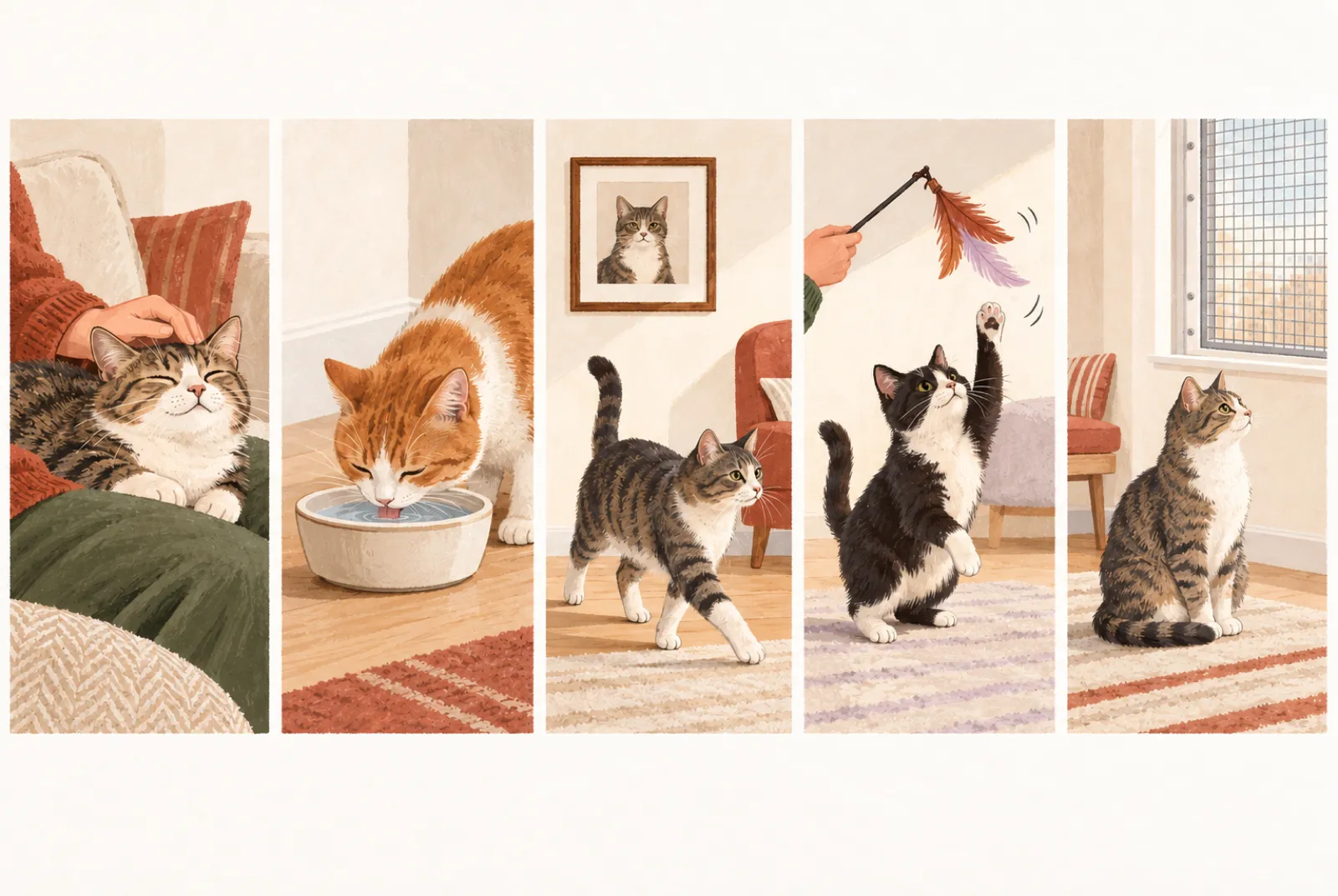
“Purring always means happy”
Purring often does accompany a contented cat — kneading on a lap, settled in a sunbeam. But Cats Protection is clear that it is only true when the body language is relaxed: cats also purr for attention, in stressful situations such as a vet visit, and sometimes when they are in pain. A purr is an offer of information, not a conclusion.
Source: Cats Protection on cat body language.
The better habit is reading the whole animal — soft eyes, loose posture, an easy tail — plus the moment around it. Our body-language guide walks through exactly that, and it is the difference between hearing a purr and understanding one.
The shape of a correction
The tidy version
“A purring cat is a happy cat.” Simple, memorable — and wrong often enough to matter.
The useful version
“A purr means something is being felt.” Contentment, asking, stress, soothing — the body says which.
The pattern: nearly every myth on this page swaps “sometimes, with context” for “always”.
“Cats should drink milk”
The saucer of milk is a cartoon inheritance. Kittens drink their mother’s milk before weaning, but once weaned many cats produce less of the enzyme that digests lactose — so cow’s milk commonly leads to an upset stomach. Cats Protection’s drinking guidance is unambiguous: cats do not need milk to stay healthy, many are lactose intolerant, and water is the drink that keeps them hydrated. Shop-bought “cat milk” is safe but fatty, and belongs as an occasional treat, not in the bowl next to dinner.
Sources: Cats Protection on cats and drinking and Cats Protection on common cat myths.
The practical version: fresh water, every day, in a spot apart from food — our feeding and water guide covers placement. If a weaned kitten or cat accidentally gets into milk and seems unwell afterwards, that is a vet question, not a myth question.
“A still photo tells a mood”
A photograph freezes a fraction of a second. It can show where the ears were, how the tail was held, what the coat looks like in that light — but not what happened before the shutter, what happened after, or what the cat chose. Reading a mood from a single frame is the same mistake as reading a mood from a purr: one signal, no context.
That is the honest basis of the photo tool on this site, and of our guide to reading a result: a photo note leads with the visible traits — coat, markings, posture — then adds possible breed cues and everyday care ideas, all provisional. It cannot confirm a breed, and it cannot tell you how a cat feels. For the context that a frame cannot hold, the body-language guide is the companion piece.
“Cats are solitary and don’t need play”
Cats have a reputation for self-sufficiency that outruns the evidence. Cats Protection describes play as important for wellbeing and key to a kitten’s development — play lets a cat practise the stalk-chase-catch sequence their brains are built around, and indoor cats in particular need that stimulation supplied deliberately. The ASPCA’s general care guidance likewise lists interactive play among everyday needs rather than optional extras.
Sources: Cats Protection on cats and play and ASPCA on general cat care.
The sociable version is subtler too: cats form real bonds with their people, and many choose company on their own terms — nearby, unbothered, present. The workable rule is a few short play sessions daily with toys that can be stalked and caught; our play and enrichment guide has the everyday version.
“Cats always land on their feet”
This one holds a grain of truth, which is exactly why it lasts. Most cats do have a righting reflex that lets them twist mid-air to land upright — but it does not always work, and it needs time and height to operate. Cats Protection notes that falls can go wrong especially from lower heights, when there is not time to right the body before the ground arrives. And a cat who lands upright has still landed: falls from windows and balconies injure cats every year.
Source: Cats Protection on common cat myths.
The practical version is boring and correct: safe routes down from high furniture, screens or distance at open windows and balconies, and a vet check after any real fall — cats can be hurt without showing it plainly.
Where myths come from and why they last
Cat myths survive because they are tidy. “Cats always land on their feet” compresses a real reflex into a guarantee. “Purring means happy” compresses a real signal into a verdict. Milk-bowl cartoons did the same job for diet. The corrections share a shape too — “sometimes, depending on the cat and the context” — which is less satisfying to say and far better for the cat who has to live with it.
That is also the honest summary of looking at cats at all: visible traits are observable, moods and pedigrees are not. When a saying tells you what a cat certainly is, check it against the cat in front of you — and where the question is a health one, let a veterinarian be the authority rather than a proverb.
Takeaway: Nearly every cat myth swaps “sometimes, with context” for “always”. The version worth keeping is the one that still watches the cat.
Sources and review
- Cats Protection: cat body language
- Cats Protection: cats and drinking
- Cats Protection: common myths about cats
- Cats Protection: cats and play
- ASPCA: general cat care
Sources last checked 2026-10-01. Sources support the statements near them; these organisations do not endorse Cat Says Hi.
Spotted an error? Tell us.
Observation over assumption
A calm photo note returns an AI-generated, provisional read of a cat’s visible coat, markings and posture, with everyday care ideas — deliberately less tidy than a myth. Nothing is sent until you select Analyze. Read the Privacy Policy for the full data-handling details.