
Trimming cat claws without a battle
Which cats actually need claw trims, how to find the quick and clip only the hooked tip, and what to do if a claw bleeds — plus when a vet or groomer should take over.
Which cats actually need trims
Here is the honest starting point: many cats never need their claws trimmed. Scratching on a suitable surface sheds the worn outer sheath and keeps the claw in working shape, so a healthy cat with scratch outlets usually manages their own pedicure. International Cat Care goes further and says routine trimming is not advisable — cats need sharp claws for climbing, playing, hunting and defence, and removing the tips takes away a tool they use daily.
Sources: International Cat Care on trimming claws and Cats Protection on trimming claws.
The cats who do need help are usually older or less mobile ones. When a cat stops scratching and climbing as much, claws can overgrow until they catch in furnishings or, in the worst cases, curl round and grow into the paw pad — painful, and a route to infection. Check claws if you notice them catching on blankets or carpets, staying visible while the cat rests, tapping on hard floors, or if the cat seems to struggle with scratching or retracting them.
Sources: International Cat Care on trimming claws and Cats Protection on trimming claws.
Sources differ a little in emphasis. VCA notes that indoor cats whose claws do not wear down may benefit from a trim every two to four weeks, particularly to spare skin and furniture; the welfare charities start from the cat’s own upkeep. A reasonable read of both: check your cat’s claws now and then, and trim only the ones that genuinely need it.
Source: VCA Animal Hospitals on trimming nails.
One claw is easy to miss during that check: the dewclaw, the short claw on the inner side of the paw that never touches the ground. Because walking never wears it down, Washington State University’s veterinary hospital warns it often grows into the skin — so give it a look whenever you check the others.
Source: Washington State University Veterinary Teaching Hospital on clipping nails.
Tools and a calm setup
Keep it simple: a pair of cat nail clippers, some treats, and styptic powder within reach in case a cut goes too deep. VCA describes two common clipper styles — scissor-type and guillotine-type — either of which works. On human nail clippers the sources gently disagree: Cats Protection advises against them because the different cutting shape can split the claw, while VCA says they can be used if you keep a pair aside for the cat alone. A dedicated pair of pet clippers is the easy low-risk answer, and it is what the welfare charities recommend.
Sources: VCA Animal Hospitals on trimming nails and Cats Protection on trimming claws.
Set up while the cat is already relaxed — after a meal or a quiet nap beats mid-play. International Cat Care suggests sitting the cat on your lap facing away from you, or resting them on a table, and a towel can wrap a wriggly cat loosely with one paw free. A second pair of hands to steady the cat is a reasonable help, as long as the cat accepts it. Whatever the position, the cat should be able to leave: a trim is a few seconds of cooperation, not a restraint exercise.
Finding the quick
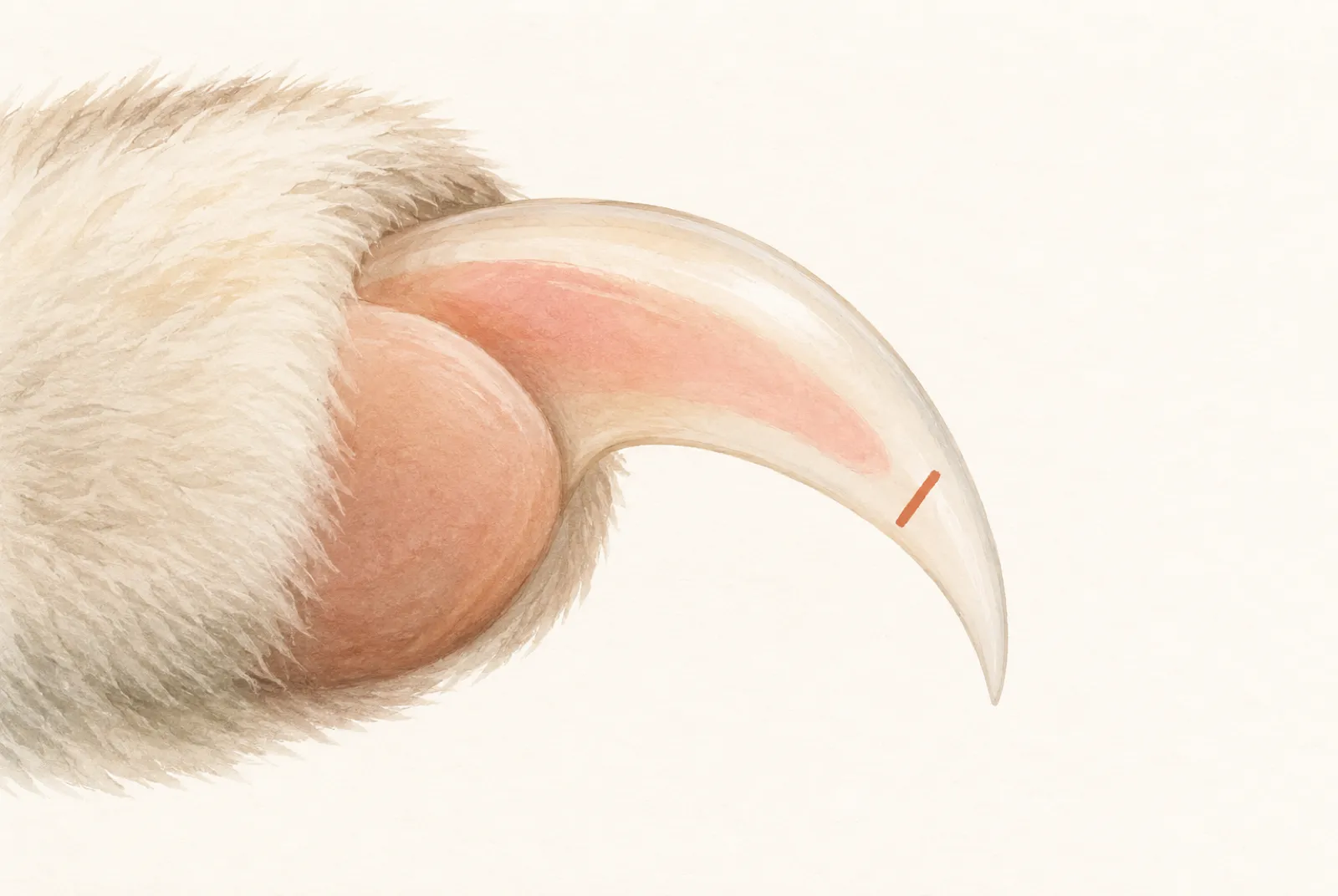
A cat’s claw sits retracted inside the toe. To bring it out, take the paw in your hand and press gently — VCA’s version is a squeeze of the middle pad between thumb and forefinger; International Cat Care describes pressing the top of the toe. The claw slides forward and shows you two zones: a pinkish inner area and a paler hooked tip beyond it.
Sources: VCA Animal Hospitals on trimming nails and International Cat Care on trimming claws.
The pink part is the quick — it carries the blood vessels and nerves, and it is the part you must not cut. On a pale claw it is easy to see. On a dark or black claw it may be hidden, so VCA’s advice is to trim where the nail curves down towards the floor and to take several small snips rather than one deep cut. In every case you are removing only the sharp, hooked tip.
Pale claw versus dark claw
A pale claw
The quick shows as a pink stripe inside. Leave a margin past the pink and clip only the curved tip.
A dark claw
No quick in sight — so don’t guess. Trim where the claw hooks downward, in small snips.
Either way: one shallow cut at a time. You can always take a little more off a tip; you cannot put it back on the quick.
VCA also suggests positioning the clippers so they cut the claw from top to bottom rather than side to side, which puts pressure across the nail in a way that is less likely to splinter it.
One paw at a time: the session
Forget the idea of doing all four paws in one sitting. Cats Protection recommends spreading the clipping over days — one paw at a time — and stopping the moment the cat becomes stressed or aggressive. Start with a single claw if that is all the cat will offer. Reward afterwards, so the session ends on something the cat likes.
Sources: Cats Protection on trimming claws and International Cat Care on trimming claws.
A low-pressure trim, step by step
- Wait for relaxedChoose a settled cat and a quiet spot, not mid-play.
- Extend the clawPress the paw pad gently until the claw slides out.
- Clip the tipOne shallow cut past the quick — never through it.
- Treat and stopReward, release the paw, and end while things are calm.
If the cat pulls away or goes tense, let them go and try another day. Pushing through a struggle teaches the cat to dread the clippers — and a cat who has learned that is much harder to trim next month.
If it goes wrong
Cutting into the quick hurts and bleeds — this is why the styptic powder was on the table. VCA suggests keeping it beside you for exactly this moment, and notes that flour or cornstarch can stand in if needed. Press a little onto the bleeding tip and keep the cat calm while it takes effect. Then stop for the day; the cat has done enough.
Source: VCA Animal Hospitals on trimming nails.
If bleeding does not settle, the toe later looks swollen, or the cat starts limping, that is no longer a grooming question — contact a veterinarian. The same applies if you ever spot a claw that appears to be growing into the paw pad.
When a vet or groomer should do it
Some cats simply will not cooperate, and that is a legitimate reason to hand the job over. VCA is blunt about it: if your cat resists restraint, stop and talk to a veterinarian rather than escalating. Vets and professional groomers trim claws routinely, can demonstrate the handling on your own cat, and can discuss options — including, in some cases, medication to take the edge off for a genuinely distressed cat.
Sources: VCA Animal Hospitals on trimming nails and International Cat Care on trimming claws.
Two things not to reach for: claw covers and declawing. Cats Protection advises never using claw covers — they are stressful for the cat, can be painful, and stop the claw retracting for scratching and grooming. International Cat Care takes the same position on covers, and describes declawing for anything other than genuine medical reasons as mutilation. If claws or furniture are the real issue, our scratching guide is the kinder fix.
Sources: Cats Protection on trimming claws and International Cat Care on trimming claws.
Takeaway: Most cats manage their own claws. For the ones who need help — tip only, one paw at a time, and a vet or groomer when the cat says no.
Sources and review
- Cats Protection: how to trim cat claws
- International Cat Care: trimming your cat’s claws
- VCA Animal Hospitals: how to trim a cat’s nails
- Washington State University Veterinary Teaching Hospital: how to clip a cat’s nails
Sources last checked 2026-10-01. Sources support the statements near them; these organisations do not endorse Cat Says Hi.
Spotted an error? Tell us.
Keeping an everyday eye on things
A calm photo note returns an AI-generated, provisional read of a cat’s coat, markings and posture, with everyday care ideas to go with them. Nothing is sent until you select Analyze, and it is never a health check. Read the Privacy Policy for the full data-handling details.