
Introducing a second cat, slowly
Cats are not automatically social with each other, so the honest answer is a staged introduction: separate rooms first, scent before sight, sight before contact, and contact that can always be undone. Here is the sequence that gives two cats the best chance.
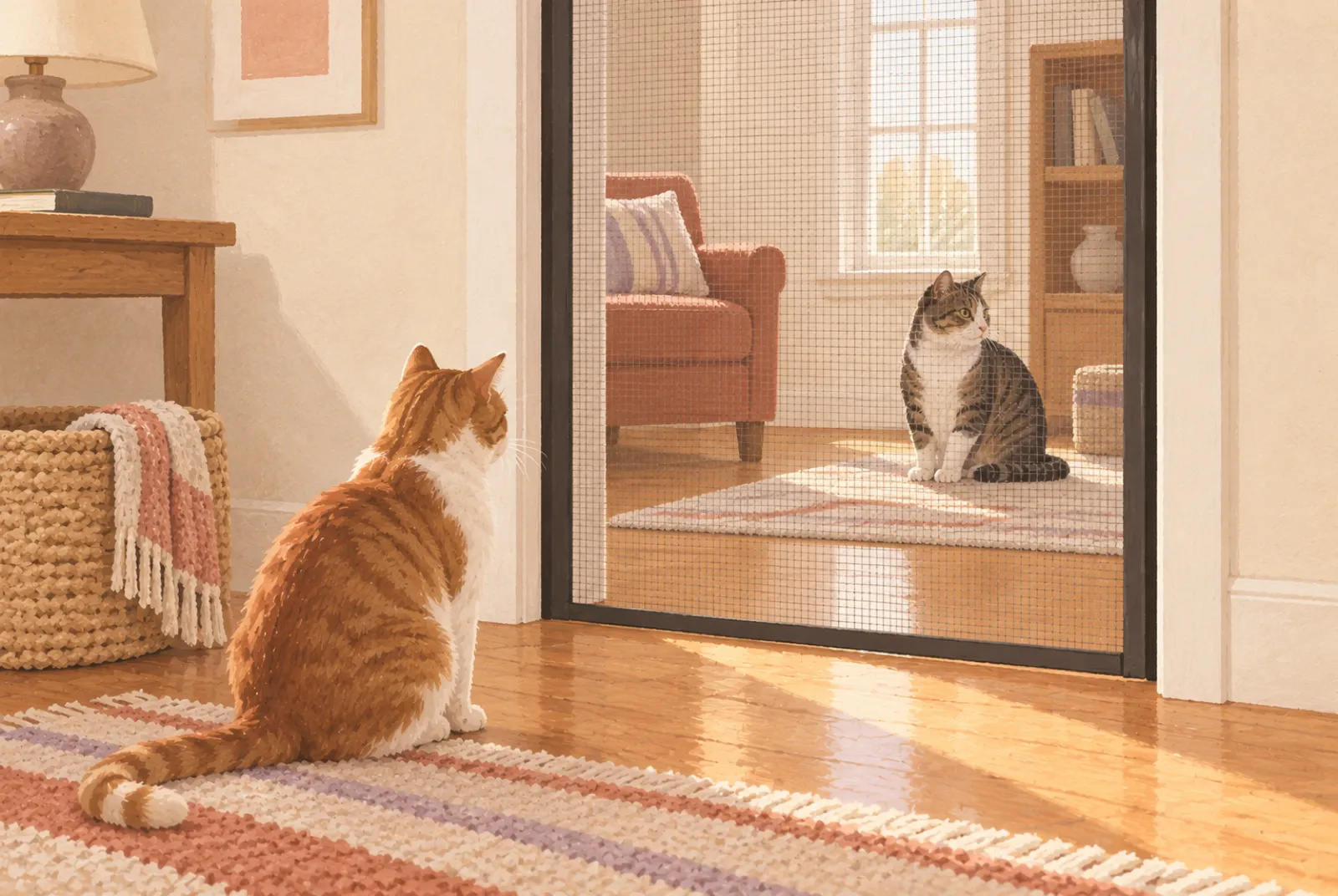
- Start with a room of their own — scent familiarity comes before the cats ever see each other.
- Climb the ladder slowly: bedding swap, room swap, visual contact through a barrier, then supervised access.
- Every cat gets their own food, water, bed, tray and scratching spot — plus one extra, spread out.
Start with separate space and scent
It helps to know what you are asking for. International Cat Care describes cats as naturally solitary animals — many can live alongside others, but some simply do not want to, and a slow, careful introduction gives any pairing its best chance. None of this is a reason not to try; it is the reason not to rush.
Source: International Cat Care on introducing cats.
The new cat starts confined to a room the resident cat does not rely on — a spare room, a study — equipped with everything they need: food, water, resting places, hiding spots, a litter tray, toys and a scratching post. International Cat Care recommends these items be new or the newcomer’s own, since things that already smell of the resident cat can feel like a rival’s claim. The same room-of-their-own logic that settles a solo arrival — our first-days checklist covers it — doubles here as the first chapter of the introduction.
Give the settling phase real time: several days to a week or two is normal. Comfort looks like a cat who greets you at the door, rests on their side, plays, rubs their face on furniture, and eats, drinks, toilets and grooms as usual. Frustration looks different — pawing at the door, sustained meowing, pacing — and means the room may need more interest or a little more space, not a faster timeline. A synthetic pheromone diffuser, plugged in where the cats spend most time, can help scent feel familiar on both sides.
Scent swapping, step by step
Once the new cat is settled, swap scent before sight. Trade a piece of bedding between the cats so each lies on fabric carrying the other’s smell — the idea is a shared, communal scent, the way cats in the same social group recognise each other. International Cat Care suggests watching what each cat does with the bedding: a cat who investigates and settles on it is telling you something different from one who avoids it or hisses at it, and a negative reaction means slower, not never.
Source: International Cat Care on introducing cats.
When bedding swaps go calmly, move to room swaps: confine the resident cat briefly and let the newcomer explore their territory, then swap back. Each cat learns the other’s scent and map without a confrontation. Repeat until both cats move through the exercise unbothered.
The introduction ladder
- Separate roomsEverything each cat needs, days to a couple of weeks.
- Scent swappingBedding first, then exploring each other’s rooms.
- Visual contactThrough a barrier — calm glances, not stares.
- Shared spaceSupervised first, then short unsupervised spells.
First visual contact
Sight comes through a barrier: a door propped just open so neither cat can pass, a stair gate, or a mesh screen. What you want is remarkably uneventful — two cats going about their business, glancing at each other occasionally rather than staring. Sniffing through the gap is fine and natural.
If either cat hisses, growls, or fixes on the other with flattened ears and a tense body, do not punish it — that teaches the cat the barrier predicts scolding. International Cat Care’s move is to interrupt gently: call the cat’s name and draw them away to a quiet room, and try again another day. One practical surprise in their guidance: skip food and toys as distractions at this stage. Cats are solitary eaters and players, and offering either near another cat can add pressure rather than relieve it — save treats for afterwards, separately.
Reading the early encounters
Once the cats share the house, watch who does what to whom rather than looking for declared friendship. International Cat Care describes social groups in multi-cat homes: cats who groom each other, sleep touching, play together and touch noses are a group — and cats may form more than one group under one roof. Quiet tension shows differently: one cat leaving the room when another enters, staring, a cat blocking another’s path to food or the tray, or the low-grade soundtrack of hissing, chasing and swiping.
Source: International Cat Care on multi-cat households.
A house map helps here — a sketch of which rooms each cat uses and where resources sit can show whether one cat controls a corridor or a doorway. And remember that relationships drift: International Cat Care advises monitoring cat-to-cat behaviour long after the introductions end, and keeping a room that can become one cat’s territory again if conflict returns.
When introductions stall
If you are stuck on a step, or the relationship breaks down after a good start, International Cat Care’s advice is to bring in help: your veterinary team can rule out anything physical and can recommend a qualified clinical animal behaviourist. Stalling is common and workable; it is not a verdict on your household.
Source: International Cat Care on introducing cats.
Two outcomes are worth naming plainly. Some pairings settle into respectful distance rather than cuddles — fine. And some cats genuinely cannot share a home; where that is the honest answer, a permanent fair arrangement of separate spaces, or in some cases rehoming on professional advice, is kinder than a forced truce. Any scratch or bite wound, and any cat who stops eating, belongs with a vet first.
Takeaway: Separate rooms, swapped scent, barriered glances, then shared space with resources to spare — go slower than feels necessary, and the cats will usually get there faster.
Sources and review
- International Cat Care: introducing cats
- International Cat Care: multi-cat households
- Ohio State University Indoor Pet Initiative: cats
Sources last checked 2026-10-01. Sources support the statements near them; these organisations do not endorse Cat Says Hi.
Spotted an error? Tell us.
Keeping an everyday eye on things
A calm photo note returns an AI-generated, provisional read of a cat’s coat, markings and posture, with everyday care ideas to go with them. Nothing is sent until you select Analyze, and it is never a health check. Read the Privacy Policy for the full data-handling details.